
Sinoxylon perforans
Sinoxylon perforans
Description
How to identify
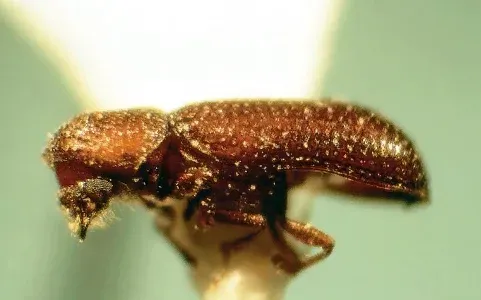
Sinoxylon perforans is a species of beetle belonging to the family Bostrichidae, often referred to as auger beetles or false powderpost beetles. The adult beetle is small, typically measuring 4 to 6 millimeters in length.
Its body is cylindrical and dark brown to black in color. The pronotum is strongly developed and covers the head like a hood, which is the most prominent feature of this family.
The elytra, or wing covers, are characterized by small bumps and spines, especially toward the posterior, which assist the beetle in maneuvering within the tunnels it excavates.
The larvae are typically C-shaped, legless, and white, with a strong head capsule adapted for boring into solid wood. They reside deep within the plant tissues, protected from external factors.
Adults are strong fliers, allowing them to disperse over significant distances to find weakened or stressed host plants suitable for colonization and egg-laying.
What it damages
This beetle is a serious wood-boring pest that primarily attacks broad-leaved trees. It is particularly known for infesting various fruit trees such as apple, pear, plum, apricot, and even grapevine.
The pest generally targets weakened trees suffering from drought, sunburn, or previous physical injuries, though it can attack healthy trees when population densities are high.
Both adults and larvae cause significant damage by creating extensive tunnels throughout the branches and trunks, which disrupts the tree's vascular system and nutrient transport.
Severe infestations often result in the wilting and death of branches, and if the damage is extensive, it can lead to the total death of the tree.
These galleries created by the beetles also serve as primary entry points for various pathogenic fungi and bacteria, leading to rot and further weakening of the woody structures.
When it appears
The flight activity of adult beetles usually begins in the spring when temperatures consistently rise, coinciding with the early stages of tree vegetation.
Depending on the climatic conditions of the region and the length of the warm season, the beetle may complete one or two generations per year.
The most intensive colonization occurs during the summer months when adult beetles are most active in finding new hosts and drilling holes for egg-laying.
Larvae feed continuously throughout the summer and autumn, enlarging their galleries within the wood and accumulating energy reserves for pupation.
Wintering occurs inside the wood as larvae or as fully developed young adults, which remain in their galleries until the return of warm weather in the following season.
Signs of infestation
The most visible sign of an infestation is the presence of numerous small, perfectly round holes on the bark, with a diameter of approximately 1 to 2 millimeters.
Near these entrance holes, one can often find piles of fine wood dust, commonly known as frass, which the beetles eject while excavating their tunnels.
Affected trees may show signs of yellowing leaves, unexpected wilting of branches, or even branch dieback, which is often misattributed to water stress or nutrient deficiency.
When an infested branch is cut, an intricate network of galleries can be observed, typically packed with boring dust and larval excrement.
In advanced stages of colonization, the bark may start to loosen, and the affected wood might exhibit signs of fungal decay due to the introduction of secondary pathogens.
Control measures
Effective management begins with good orchard hygiene and cultural practices, ensuring trees are healthy and vigorous through proper irrigation and fertilization.
Sanitary pruning is a critical control measure: all infested branches showing signs of boring holes must be removed promptly and destroyed by burning.
- Installation of pheromone traps to monitor adult beetle flight activity.
- Use of sticky bands or traps to reduce the number of adults in the orchard.
- Whitewashing trunks to protect bark from sunburn and deter initial boring.
- Targeted application of systemic insecticides during the peak periods of adult activity.
Controlling this beetle is challenging because of its hidden life cycle; therefore, all chemical applications must be synchronized with the beetle's life stages.
In cases of severe infestation, removing and destroying entire trees is recommended to prevent them from becoming breeding hubs that endanger the rest of the orchard.
Taxonomy
- Latin name
- Sinoxylon perforans
- Order
- Coleoptera (beetles)
- Family
- Bostrichidae
- EPPO code
- SINOPE
Discussion
No discussions yet — be the first.