
Sinoxylon indicum
Sinoxylon indicum
Description
How to identify
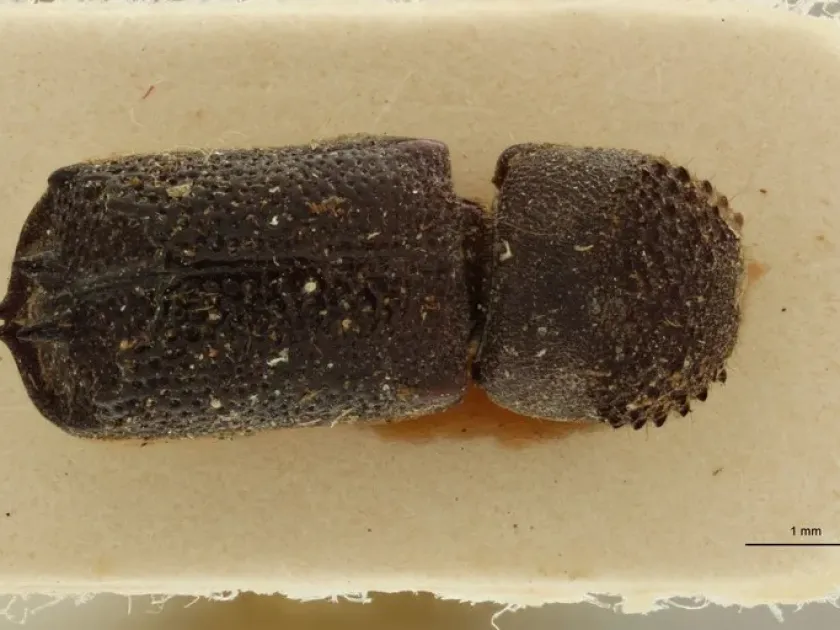
Sinoxylon indicum is a species of auger beetle belonging to the family Bostrichidae. These beetles are easily identified by their cylindrical body shape and dark, often black or deep reddish-brown coloration.
The most distinctive feature of these beetles is the pronotum, which forms a hood-like structure covering the head. The surface of the elytra often displays rough textures, tubercles, or small spines near the apex.
Larvae are typically white or cream-colored, with a characteristic curved shape and well-developed thoracic legs. They are specifically adapted to tunnel through hard, dry wood throughout their larval stage.
Adult beetles range in size from 4 to 7 mm. They are primarily nocturnal but become highly active during the dispersal phase when they fly to colonize new host trees or timber piles.
The taxonomy of Sinoxylon indicum places it among significant wood-destroying insects that thrive in tropical and subtropical climates, often causing considerable damage to local ecosystems.
What it damages
This pest mainly attacks various hardwood species, including both forest trees and agricultural crops such as citrus and other fruit-bearing trees. It frequently targets stressed or recently felled timber.
The damage is primarily caused by both larvae and adults boring into the sapwood and heartwood. This activity destroys the structural integrity of the wood and disrupts the transport of water and nutrients.
Host plants commonly affected include various species of Acacia, legumes, and several ornamental trees. In orchards, the infestation can lead to branch dieback and eventually the death of the entire tree.
Economically, this beetle is a major threat to timber industries, as it renders lumber and logs useless for structural or furniture purposes due to the dense network of tunnels created inside the wood.
In high-infestation scenarios, the cumulative effect of boring insects can lead to the rapid decline of entire groves or timber stockpiles, necessitating strict quarantine and management measures.
When it appears
The life cycle of Sinoxylon indicum is heavily dependent on thermal conditions. Warm temperatures facilitate rapid development and high metabolic activity in the beetles.
The adult flight period generally begins in late spring, continuing throughout the summer and early autumn. This is the critical window for mating and finding suitable host materials.
Larval development typically spans several months. Depending on the environmental temperature, multiple generations can occur within a single year in tropical zones.
Winter survival is usually achieved in the larval stage, protected deep within the woody tissue. This allows the population to persist even in regions with milder, shorter cold seasons.
Outbreaks are frequently triggered by periods of prolonged drought or heat stress, which reduce the natural resistance of trees and make them more susceptible to colonization by wood-borers.
Signs of infestation
One of the earliest signs of an Sinoxylon indicum infestation is the presence of small, perfectly circular entry holes on the bark of trunks or branches.
A fine, powdery dust, known as frass, often accumulates around these holes or at the base of the tree, indicating active boring activity within the wood.
Visible symptoms on living trees include thinning foliage, premature yellowing, and the localized wilting or drying of branches, which indicates internal tissue damage.
If the bark is removed, one can observe a complex maze of interconnected tunnels. These tunnels are typically packed with a mixture of woody debris and larval excrement.
In quiet settings, such as warehouses or silent forests, a distinct scratching or rasping sound can sometimes be heard coming from within the wood as larvae feed.
Control measures
The most effective management strategy involves sanitation: removing and destroying infested branches or timber to reduce the local population and prevent the spread to healthy trees.
Storage of timber should be prioritized in dry, well-ventilated areas, and bark should be removed if long-term storage is required to make the wood less attractive to the beetles.
Chemical control is challenging due to the hidden lifestyle of the larvae. Systemic insecticides may offer some protection for high-value ornamental trees, but timing is critical during adult flight periods.
- Monitoring with pheromone or light traps to detect adult activity.
- Pruning and burning of damaged plant material.
- Using fumigation for timber and logs in industrial settings.
For large-scale protection of lumber, industrial fumigation remains the standard method to eradicate all life stages of the beetle, ensuring the wood is safe for commercial use.
Taxonomy
- Latin name
- Sinoxylon indicum
- Order
- Coleoptera (beetles)
- Family
- Bostrichidae
- EPPO code
- SINOIN
Discussion
No discussions yet — be the first.