
Grape shot-hole borer
Scobicia declivis
Description
How to identify
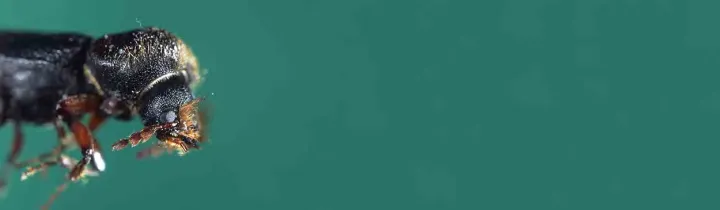
The Grape shot-hole borer (Scobicia declivis) is a member of the Bostrichidae family, known as the auger beetles or horned powder-post beetles. The adult beetle is a small insect, ranging from 5 to 8 mm in length, with a cylindrical, dark brown or blackish body.
The name "shot-hole borer" comes from the unique morphology of their thorax, which forms a hood-like structure covering the head. This protective shield is covered in rough tubercles and sharp spines that aid in burrowing.
The larvae are white, C-shaped grubs with no legs. They spend their entire developmental phase inside the woody stems of the host plant, effectively shielded from external predators and many contact pesticides.
Adult beetles are highly mobile and capable of flight, often emerging in late spring and summer to search for suitable host plants. They are most active during the evening hours when they mate and lay eggs.
Although they prefer stressed or dying wood, in high-density populations, these beetles can successfully attack healthy and vigorous vines, potentially causing significant structural damage to the grapevine.
What it damages
These beetles primarily target the woody tissue of grapevines, including permanent cordons and older trunks. The damage is caused by both larvae and adults as they tunnel deep into the vascular tissue.
Beyond grapevines, Scobicia declivis is known to infest a variety of other woody species, including fruit trees like apples, pears, and stone fruits, making it a generalist threat in mixed orchard environments.
The primary impact of the infestation is the destruction of the xylem and phloem, which disrupts the flow of water and nutrients throughout the vine. This can lead to the wilting and dieback of entire branches.
Bored holes create entry points for secondary pathogens, such as wood-decay fungi and bacterial infections, which accelerate the deterioration of the wood and can eventually kill the vine.
In cases of severe infestation, the cumulative structural weakness of the woody framework leaves the vines highly susceptible to mechanical breakage during strong winds or under the weight of a heavy harvest.
Signs of infestation
The most telltale sign of an infestation is the presence of small, perfectly circular holes on the bark of woody stems. These entrance holes are usually 2 to 3 millimeters in diameter.
A fine, wood-colored dust known as "frass" is often seen accumulating near the entrance holes or falling onto the ground beneath the affected vine limbs, serving as a clear indicator of active boring activity.
Vines infested with shot-hole borers may exhibit signs of decline, such as yellowing leaves, premature senescence, or wilting branches that do not recover even after sufficient irrigation.
Closer inspection of the affected areas may reveal small ridges or ruptures in the bark. When a damaged limb is sliced open, the internal wood will show distinct, winding galleries packed with granular wood dust.
During the early spring, impacted vines frequently show delayed bud break or stunted growth, as the beetle activity has compromised the vine's ability to mobilize stored energy for the new season.
Control measures
The cornerstone of management for the Grape shot-hole borer is strict sanitation. All dead, dying, or severely infested vine material must be removed and destroyed by burning to prevent the spread of the population.
It is vital to clear the vineyard floor of any prunings or wood debris immediately after pruning. Piles of abandoned wood act as major breeding reservoirs for the beetles throughout the summer months.
Chemical control can be effective if timed with the peak flight period of adult beetles. Systemic insecticides are preferred as they provide better protection for the inner woody tissues of the plant.
Cultural practices that promote vine vigor, such as balanced irrigation and appropriate fertilization, help the grapevine withstand minor infestations and recover more effectively from boring damage.
- Sanitize the vineyard by removing and burning infested wood.
- Monitor adult beetle activity using flight traps during spring.
- Apply systemic insecticides during the beetle emergence period.
- Paint large pruning wounds with specialized sealants to prevent entry.
Taxonomy
- Latin name
- Scobicia declivis
- Order
- Coleoptera (beetles)
- Family
- Bostrichidae
- EPPO code
- SCOCDE
Discussion
No discussions yet — be the first.