
Lesser grain borer
Rhyzopertha
Description
How to identify
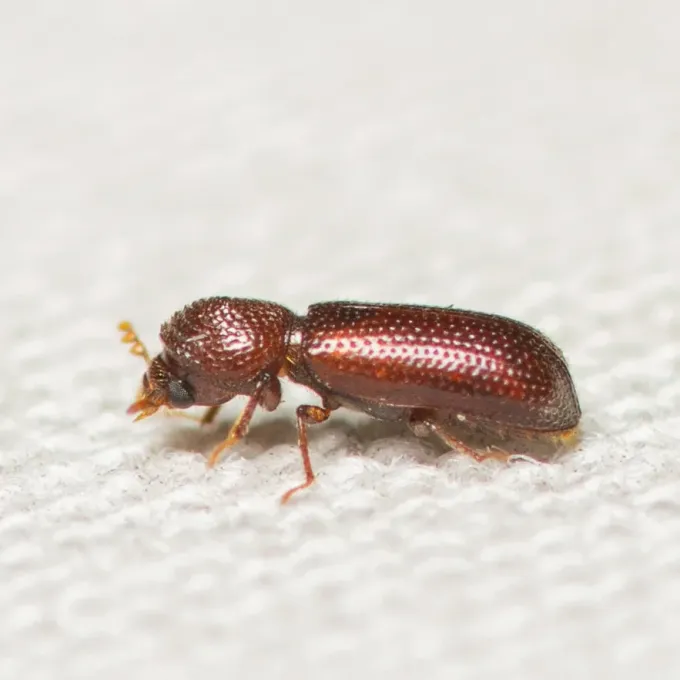
The Lesser grain borer (Rhyzopertha dominica) is a small beetle belonging to the Bostrichidae family. The adult beetle is cylindrical, roughly 2.5–3 mm long, with a dark brown or blackish appearance.
A key identifying feature is the pronotum, which is shaped like a hood and covers the head completely when viewed from above, a characteristic trait of this species.
The wing covers (elytra) are marked with rows of distinct pits, giving the beetle a rough texture that helps distinguish it from other grain pests like the flour beetle.
Larvae are white, crescent-shaped, and possess a small head; they are highly mobile in their early stages until they bore into the grain kernel to feed.
Adults are strong fliers and are attracted to the odors emitted by stored grain, allowing them to infest clean warehouses rapidly during the warmer months.
What it damages
This pest is a major threat to stored cereal crops, including wheat, rice, corn, barley, and sorghum, as well as processed food products like pasta and flour.
Both adults and larvae are highly destructive; adults chew irregular holes in the grain, while larvae tunnel into the kernel, consuming the endosperm completely.
Infested grain becomes infested with fine flour dust and frass, significantly reducing its weight, nutritional value, and market grade for sale or export.
Large-scale infestations often lead to heating of the grain bulk, which facilitates the growth of molds and further lowers the quality of the stored commodity.
In addition to direct loss of volume, the pests contaminate grain with their excretions, making it unsuitable for human or animal consumption without treatment.
When it appears
Inside temperature-controlled warehouses, the Lesser grain borer can complete its life cycle continuously throughout the year, regardless of the outdoor season.
A single female can lay hundreds of eggs individually or in clusters on the surface of the grain kernels during her lifespan, depending on environmental conditions.
The developmental period from egg to adult takes approximately 30 to 45 days, depending on ambient temperature and the moisture content of the grain.
The species thrives in warm and relatively dry conditions; it is less active at temperatures below 15°C, but remains a persistent threat in tropical and temperate regions.
Multiple generations occur annually, allowing the population to reach explosive numbers if preventative measures are not taken in time to break the cycle.
Signs of infestation
The most prominent sign of infestation is the accumulation of fine, white or tan dust on the surface of the grain pile, resulting from the boring activity of adults.
Visual inspection of individual kernels reveals characteristic circular boreholes where larvae have penetrated or adults have been feeding on the outer surface.
The presence of a peculiar, sweet or musty odor in the silo often indicates high levels of pest activity and the associated heating of the grain bulk.
Regular sampling with a probe allows for the detection of insects in the lower layers of the silo where initial infestations often begin undetected.
- Presence of fine flour dust on grain surface.
- Visible boreholes on grain kernels.
- Elevated temperatures within the grain bulk.
- Detection of adults on sticky traps or in surface samples.
Control measures
Sanitation is the first line of defense: cleaning all residues from equipment, bins, and storage areas before introducing new grain to remove potential refugia.
Controlling grain moisture levels (keeping them below 12-13%) significantly reduces the success rate of larval development and hinders the overall population growth.
Fumigation is the most effective method for controlling established infestations, typically using phosphine gas under airtight conditions to ensure deep penetration.
Mechanical cleaning through aeration and screening processes helps remove infested kernels and dust, thereby reducing the insect population density.
Monitoring using pheromone traps and temperature sensors is essential for early detection and for making timely decisions regarding chemical intervention.
Taxonomy
- Latin name
- Rhyzopertha
- Order
- Coleoptera (beetles)
- Family
- Bostrichidae
- EPPO code
- RHITSP
Discussion
No discussions yet — be the first.