
Larger grain borer
Prostephanus truncatus
Description
How to identify
The Larger grain borer (Prostephanus truncatus) is a significant beetle pest belonging to the family Bostrichidae, known for its destructive habits.
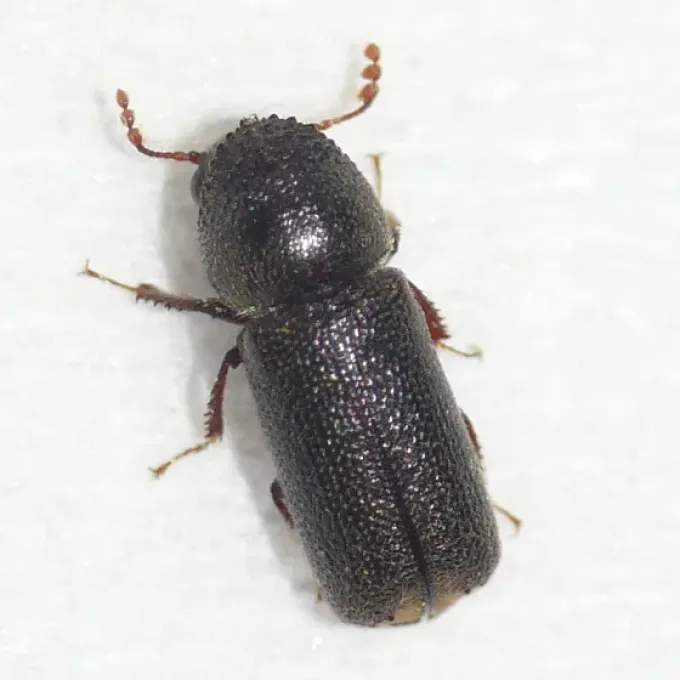
Adult beetles are cylindrical in shape, measuring between 3 and 4.5 mm, and possess a dark brown to blackish coloration.
Their head is characteristically concealed by a robust pronotum, which features distinct tubercles or teeth, giving them a hood-like appearance.
The larvae are typically C-shaped, creamy-white in color, with a brownish head capsule and well-developed legs for active movement.
Unlike many other storage pests, these beetles are capable of boring through extremely hard materials, including wood and plastic storage containers.
What it damages
This pest is most infamous for attacking maize, damaging both kernels on the cob and shelled grain, often leading to total loss of quality.
Besides maize, the species can infest wheat, sorghum, cassava, dried legumes, and various wooden structures within storage facilities.
The beetles burrow into the grain, consuming the inner starch and leaving behind significant quantities of fine, floury dust and empty hulls.
Due to their high reproductive rate, they can reduce grain weight by up to 40% within a relatively short period of storage.
Damaged grain is highly prone to secondary infections, including molds and mycotoxins, which further degrade the food safety standards.
When it appears
The life cycle and population dynamics of the Larger grain borer are heavily influenced by temperature and grain moisture levels.
The beetle thrives in warm environments with temperatures around 30 °C and prefers higher humidity levels to optimize larval growth.
The entire developmental period from egg to adult takes approximately 30 to 40 days, allowing for several generations throughout the year in warm climates.
In colder conditions, the beetle's metabolism slows down, though it can survive in sheltered areas waiting for warmer weather.
Infestations typically peak during the warmer months, although storage facilities with poor climate control can harbor pests year-round.
Signs of infestation
A primary indicator of an infestation is the presence of fine, powdery dust accumulating at the base of grain piles or storage bags.
Kernels of corn often display perfectly round, drilled exit holes, indicating the presence of adults that have recently emerged.
Observing the surface of the grain often reveals adult beetles crawling, which are quite active compared to more sluggish storage weevils.
Severe infestations produce a distinct musty odor resulting from the breakdown of the grain and the proliferation of secondary microorganisms.
Screening samples of the stored product will reveal empty, hollowed-out grains mixed with larval stages and insect excrement.
Control measures
Strict phytosanitary measures are essential to prevent the transboundary movement of infested grain shipments from endemic areas.
Proper drying of harvested grain to below 12% moisture content is a key agronomic practice to discourage the beetle's colonization.
Regular sanitation of storage facilities, including the removal of old crop residues, helps eliminate potential breeding sites.
Fumigation with approved phosphine-based products is the standard procedure for eliminating active infestations within stored bulk grain.
- Using pheromone-baited traps for early detection and population monitoring.
- Employing hermetic storage technology to starve the pests of oxygen.
- Applying residual insecticides on warehouse surfaces to prevent re-infestation.
Taxonomy
- Latin name
- Prostephanus truncatus
- Order
- Coleoptera (beetles)
- Family
- Bostrichidae
- EPPO code
- PROETR
Discussion
No discussions yet — be the first.