
Polycaon chilensis
Polycaon chilensis
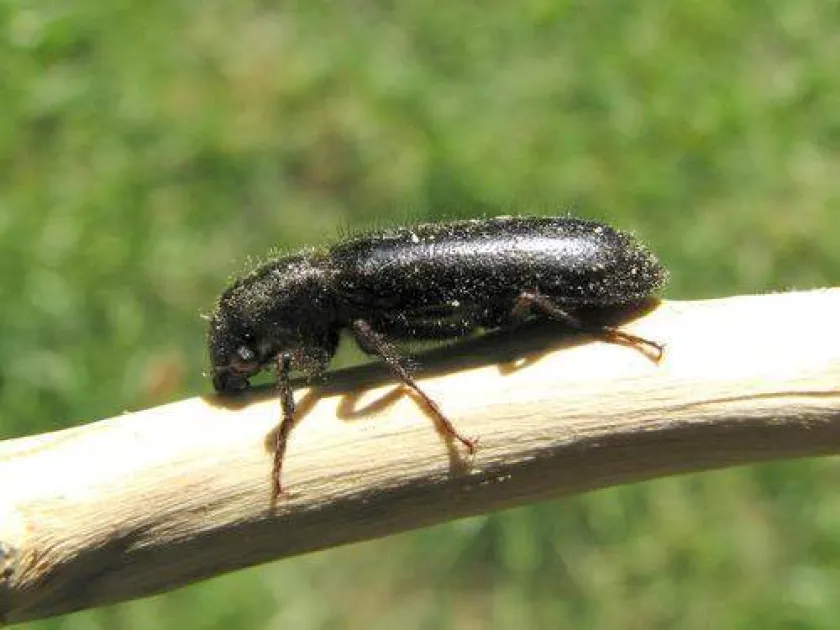
Description
How to identify
Polycaon chilensis belongs to the family Bostrichidae, commonly known as auger beetles. These insects are characterized by a cylindrical body and a dark, robust appearance, typical of many wood-boring species.
Adult beetles typically measure between 15 and 25 millimeters in length. Their head is often partially or completely concealed by the pronotum, which features prominent tubercles and projections, giving the insect a distinct hooded look.
The larvae are white, fleshy, and legless, specialized for tunneling through dense wood tissues. Their morphology is perfectly adapted to survive and feed inside the xylem of their host trees.
The life cycle of this beetle is strictly tied to the condition of the host, as they primarily colonize weakened, dying, or recently felled timber to complete their development.
Identification often requires careful inspection of the pronotum and antennae, as this species shares visual characteristics with other members of the Bostrichidae family found in South America.
What it damages
This pest mainly affects various deciduous tree species. Fruit trees and other woody plants under physiological stress are particularly susceptible to infestations.
The primary damage is caused by the larvae, which bore deep, winding galleries throughout the trunk and large branches, disrupting the vascular system of the tree.
Such structural damage restricts the movement of water and nutrients, which eventually leads to the wilting and death of affected branches or the entire tree.
In cases of high population density, Polycaon chilensis can compromise the integrity of the wood, making trees prone to snapping during strong winds.
Furthermore, the galleries created by the larvae provide entry points for secondary pathogens, such as wood-decay fungi, which further degrade the health of the host.
Signs of infestation
The most visible signs of an infestation are small, circular entry or exit holes on the surface of the bark, marking the points where the beetles have penetrated the wood.
The presence of fine frass, appearing as wood dust at the base of the tree or caught in bark crevices, is a clear indicator of active larval tunneling inside the wood.
Gradual dieback of the crown or specific branches that lack a clear pathology cause is often associated with the internal structural damage caused by these borers.
Upon closer inspection, the bark over the affected areas may appear slightly depressed or brittle, suggesting that the interior wood has been hollowed out.
In mature stands, the sudden presence of adult beetles near the canopy during twilight hours can indicate an active breeding population within the vicinity.
Control measures
The most effective management practice involves the removal and destruction of heavily infested trees or branches to eliminate breeding sites and reduce the pest population.
Enhancing tree vigor through proper irrigation and balanced fertilization significantly improves a tree's ability to resist colonization by wood-boring pests.
Applying contact or systemic insecticides during the peak flight period of adult beetles can prevent new infestations and limit the spread of the insect.
The use of pheromone-baited traps is recommended for monitoring population trends and timing chemical interventions effectively in orchards or forestry nurseries.
Regular monitoring during the growing season allows for early detection, enabling landowners to implement cultural control methods before the damage becomes irreversible.
Taxonomy
- Latin name
- Polycaon chilensis
- Order
- Coleoptera (beetles)
- Family
- Bostrichidae
- EPPO code
- PCAOCH
Discussion
No discussions yet — be the first.