
Wood borer
Heterobostrychus hamatipennis
Description
How to identify
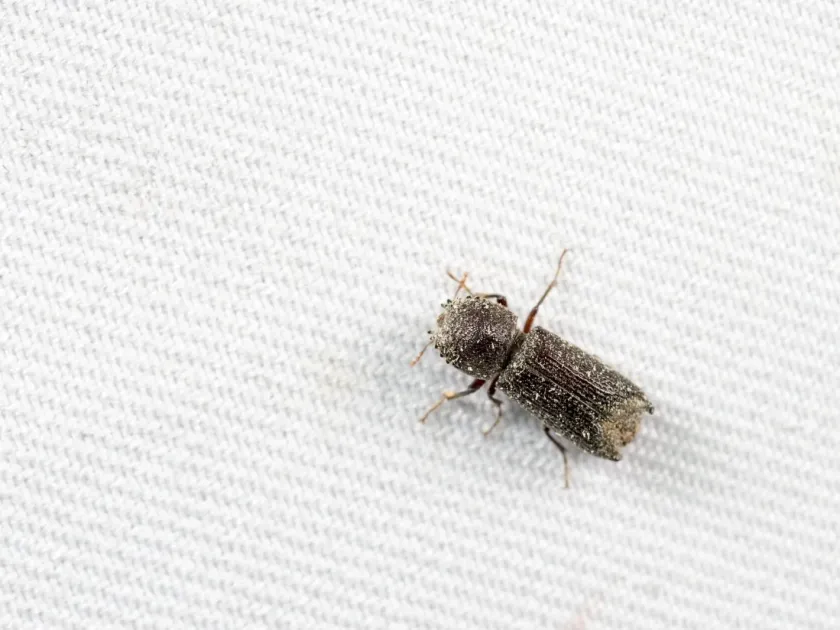
The wood borer, scientifically known as Heterobostrychus hamatipennis, belongs to the Bostrichidae family. These insects are commonly referred to as auger beetles due to their unique drilling capabilities.
Adult beetles are typically 6 to 12 mm long, featuring a cylindrical, elongated body and a dark brown or black coloration. Their distinctive "hooded" pronotum covers the head, a common trait for this family.
The larvae are small, white, C-shaped grubs with powerful mandibles designed for boring through hardwoods. They remain hidden inside the wood throughout their developmental stages.
The life cycle involves complete metamorphosis, where the insects thrive in warm and humid environments, often resulting in multiple generations per year in tropical or heated regions.
Adults are known to be active flyers, which allows them to easily colonize new timber stocks or wooden structures located near existing infestation sites.
What it damages
This beetle is a significant wood-destroying pest that primarily attacks hardwoods. It poses a major threat to both natural forests and harvested timber products.
Infestations commonly affect plywood, furniture, flooring, and structural timbers. The economic impact is high because the damaged wood loses its structural integrity and aesthetic value.
In addition to raw lumber, the beetle frequently damages shipping crates and pallets, facilitating its spread across different regions via international trade routes.
The larvae bore deep, winding galleries throughout the timber, turning the inner core into a dense mass of pulverized wood fibers, often leaving only the outer surface intact.
High moisture content in wood makes it more susceptible to infestation, although some species can also survive in relatively dry, processed wood materials.
Signs of infestation
The most evident sign of an infestation is the presence of small, circular exit holes on the surface of the wood, usually measuring 2 to 3 mm in diameter.
Fine, flour-like frass (wood dust) accumulating beneath the infested wooden objects is a clear indicator that the larvae are actively boring inside the material.
Listeners may sometimes hear faint, dry tapping or clicking sounds emanating from the wood, which are caused by the larvae feeding on the dense fibers.
Surface deformations, such as subtle ridges or depressions, may appear on furniture or beams as the internal damage progresses and the wood structure weakens.
Occasionally, live or dead adult beetles can be found near the site of infestation, especially during the mating season when they emerge from the wood.
Control measures
Preventing wood borer infestations starts with proper kiln-drying of timber, which effectively kills all life stages of the insect by reaching necessary temperatures.
For existing structures, applying specialized insecticide treatments and wood preservatives can prevent future attacks and eliminate existing populations in some cases.
Fumigation is considered the most reliable method for treating heavily infested timber, as the gas can penetrate deep into the galleries created by the larvae.
Maintaining a low humidity level in storage areas is crucial, as wood borers prefer environments that support the health of their developing brood.
Proper inventory management, including regular inspections of wooden goods, helps detect infestations early and limits the spread to non-affected material.
Taxonomy
- Latin name
- Heterobostrychus hamatipennis
- Order
- Coleoptera (beetles)
- Family
- Bostrichidae
- EPPO code
- HETBHA
Discussion
No discussions yet — be the first.