
Brown wood borer
Heterobostrychus brunneus
Description
How to identify
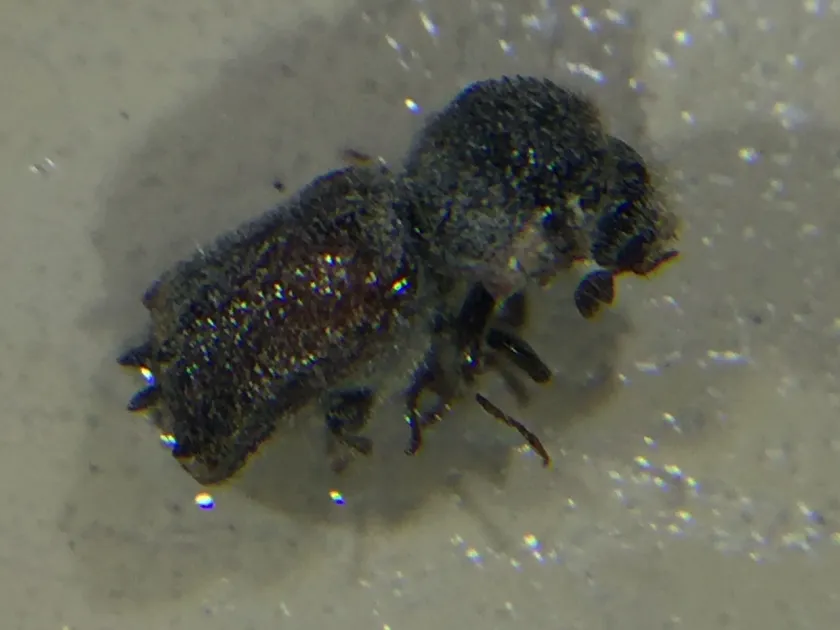
The brown wood borer (Heterobostrychus brunneus) belongs to the family Bostrichidae within the order Coleoptera. Adult beetles measure between 6 and 15 mm in length and have a cylindrical, dark brown body.
A distinctive feature of this species is the pronotum, which is strongly sloped forward, covering the head like a hood. This morphology gives the beetle its characteristic "hood-like" appearance.
The wing covers (elytra) are punctured, and males possess distinct spikes at the posterior end of the elytra, which are used for taxonomic identification of the species.
Larvae are white, C-shaped, and possess robust mandibles designed for boring through dense wood fibers. They grow significantly in size throughout the larval stage as they consume the substrate.
Adults are strong fliers and are highly active during warmer periods. They are attracted to wood suitable for oviposition, allowing them to spread effectively between structures and warehouses.
What it damages
This pest specializes in infesting hardwood species. It causes extensive damage to both timber products in storage and finished wooden structures or furniture.
Commonly affected items include plywood, flooring, cabinets, and structural wooden beams. Tropical timber species are particularly susceptible to infestations by this beetle when imported.
Beyond physical destruction, the pest causes severe economic losses by compromising the structural integrity of wooden construction elements, potentially leading to failure of the material.
The larvae tunnel deep within the wood, creating a network of galleries. The exterior surface often remains largely intact for a long time, hiding the extensive internal destruction caused by the pest.
Over time, the affected wood is reduced to fine powder, leaving only a thin surface layer intact, which is why infestations are often discovered only when the damage is already severe.
Signs of infestation
The most visible sign of an infestation is the presence of small, circular exit holes, approximately 2–3 mm in diameter, on the surface of the wood where adults have emerged.
Piles of fine, wood-colored frass (boring dust) can often be found beneath these holes, indicating that larvae are actively feeding and tunneling within the timber.
In quiet environments, one may hear a slight rasping or ticking sound coming from the wood, which is caused by the larvae chewing through the dense internal structure.
The surface of the affected material might show localized depressions or swelling. In advanced cases, the wood may feel brittle or sound hollow when tapped, confirming internal degradation.
Finding dead adult beetles near wooden structures or furniture during the summer months is a strong indicator that an infestation may be present in the immediate vicinity.
Control measures
Preventive measures include treating timber with long-lasting residual insecticides before it is used in manufacturing to deter beetles from laying eggs on the surface.
For existing infestations, professional fumigation is the most effective method, as the gas can penetrate deep into the larval galleries, reaching pests where topical treatments fail.
Small-scale infestations in furniture can sometimes be managed by injecting insecticides directly into the exit holes or using specialized wood preservative treatments.
Heat treatment is highly recommended for industrial applications. Exposing infested wood to temperatures above 60 degrees Celsius for an appropriate duration ensures complete eradication of all life stages.
Maintaining a clean storage environment, using dry and kiln-dried timber, and monitoring for early signs of entry holes are essential steps in preventing a brown wood borer outbreak.
Taxonomy
- Latin name
- Heterobostrychus brunneus
- Order
- Coleoptera (beetles)
- Family
- Bostrichidae
- EPPO code
- HETBBR
Discussion
No discussions yet — be the first.