
Auger beetle
Heterobostrychus
Description
How to identify
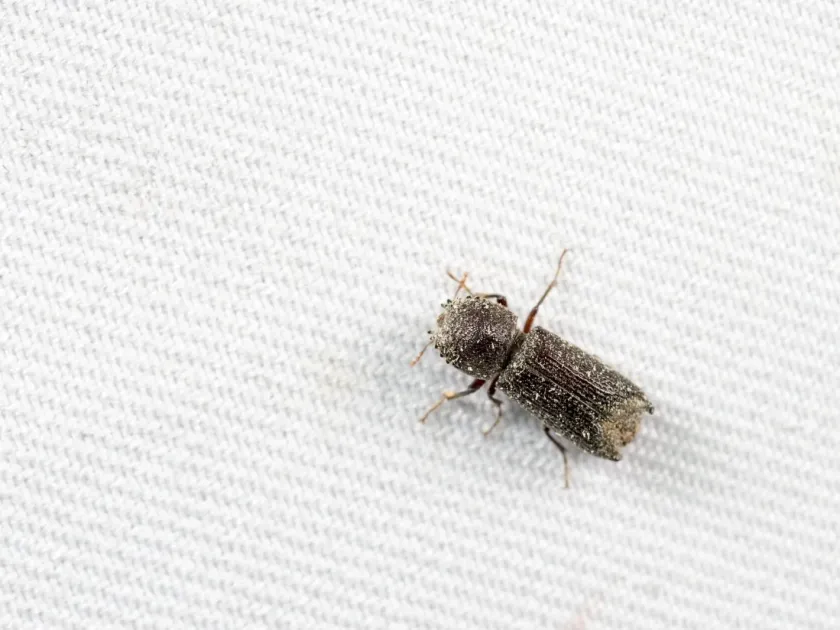
The Auger beetle, belonging to the family Bostrichidae, is a wood-boring insect with a distinct appearance. Adults have a cylindrical body measuring between 6 and 15 mm, typically colored dark brown or black.
The pronotum of this pest is heavily curved and covered with sharp, powerful teeth, giving it the appearance of a hood that hides the head. The head itself is rarely visible from above, being tucked deep into the thorax.
Larvae are whitish, C-shaped, and possess well-developed mouthparts for boring into wood. They lead a cryptic lifestyle, spending their entire life cycle hidden deep within the wooden substrate.
A key diagnostic feature of these beetles is the three-segmented club at the end of their antennae. They possess hard, durable elytra, often covered in small pits or punctures, providing protection against external threats.
Species of the genus Heterobostrychus are frequently found in tropical regions but are notorious for hitchhiking on imported timber and wooden furniture, allowing them to spread globally.
What it damages
This pest is a specialized wood-borer, primarily attacking seasoned or dried hardwoods. It infests a wide range of materials, including valuable timber, furniture, flooring, and structural beams.
Auger beetles pose a significant threat to the timber industry and lumber storage facilities. They can infest everything from construction plywood to exotic wood imports, significantly degrading the structural integrity of the material.
While their primary focus is dead or dry wood, they may also attack weakened or dying trees in forests. In agricultural settings, they can infest parts of fruit trees that have necrotic or damaged bark sections.
The damage is caused by both adults and larvae boring extensive tunnels. They pulverize wood fibers into a fine, powdery frass, which eventually turns the internal part of the wood into a porous, weak structure.
Severe infestations can render wood products completely unusable. The economic damage is particularly high in historical collections, museums, or luxury real estate where decorative wooden elements are present.
Signs of infestation
The most prominent sign of an Auger beetle infestation is the appearance of small, perfectly circular exit holes on the surface of the wood. These are created by adults emerging after completing their development.
Below or near the infested wood, you will often find fine, flour-like dust known as frass. Unlike other wood-boring beetles, this dust is typically very compact and fine, filling the galleries bored by the larvae.
Tapping on infested wood often produces a hollow sound, indicating that the interior has been turned into a network of tunnels. The wood loses its original weight and density, becoming brittle.
During peak activity, adults may be seen flying toward light sources at night. Their presence near lights or windows in warehouses is often an early indicator of a developing infestation within the premises.
Close visual inspection often reveals the aforementioned entrance/exit holes, sometimes accompanied by small mounds of wood dust, signaling active larval feeding within the timber.
Control measures
Strict quarantine and inspection protocols for imported timber are the first line of defense. All wood materials must undergo either heat treatment or fumigation to ensure that all stages of the beetle are destroyed.
For indoor infestations, the application of residual insecticides designed to penetrate wood surfaces can prevent females from laying eggs. This creates a chemical barrier on the surface of the wood.
In cases of localized infestation, injecting specialized formulations directly into the flight holes can effectively kill the larvae inside the galleries. This method is common for treating antique furniture or beams.
Maintaining proper moisture levels is crucial, though Auger beetles are particularly fond of dry, seasoned wood. Adequate ventilation helps prevent the initial attractiveness of the wood to the beetles.
- Remove and destroy severely infested wooden elements by burning them.
- Apply professional wood preservatives based on permethrin or other pyrethroids.
- Regularly monitor wooden structures using light traps to detect adult activity.
Taxonomy
- Latin name
- Heterobostrychus
- Order
- Coleoptera (beetles)
- Family
- Bostrichidae
- EPPO code
- HETBSP
Discussion
No discussions yet — be the first.