
Bamboo borer
Dinoderus porcellus
Description
How to identify
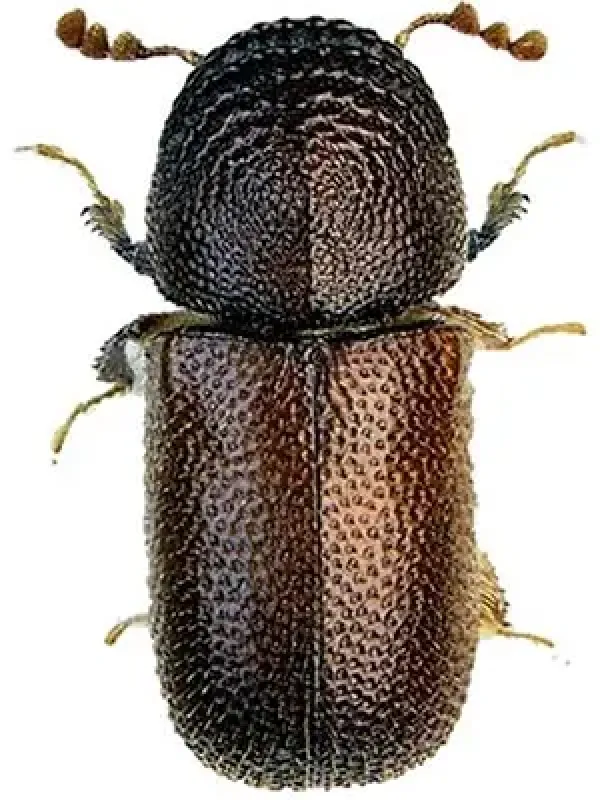
The bamboo borer (Dinoderus porcellus) is a member of the Bostrichidae family within the order Coleoptera. Adult beetles are small, typically ranging from 3 to 4 mm in length, and exhibit a cylindrical body shape.
The coloration of these beetles ranges from reddish-brown to dark brown or black. The pronotum is heavily convex and features small teeth on the front, giving the insect a distinctive hood-like appearance, which is a hallmark of the family.
The head is largely retracted under the pronotum and is rarely visible from above. A critical diagnostic feature for identifying Dinoderus porcellus is the antenna structure, which terminates in a three-segmented club.
Larvae have a curved, white appearance with well-developed mouthparts designed for boring into dense plant fibers. They spend their entire development cycle hidden within the substrate they feed on.
Due to the morphological similarities with other species in the Dinoderus genus, precise identification often requires microscopic examination of structural details by specialized entomologists.
What it damages
This pest is a major threat to dry bamboo, rattan, and other high-starch plant materials. It is particularly notorious for damaging bamboo products, furniture, and stored construction materials.
In addition to bamboo, the beetle can infest a variety of stored dry food products, including cereals, flour, and dried roots, making it a significant pest in both wood and food storage facilities.
The beetle is particularly attracted to materials with high starch content. Freshly harvested or inadequately dried bamboo provides the perfect environment for female beetles to lay their eggs.
The damage is primarily caused by larvae, which tunnel extensively through the timber. This activity destroys the structural integrity of the bamboo, rendering it hollow, brittle, and worthless for commercial use.
Large-scale infestations can cause substantial economic losses, as massive quantities of goods can be ruined within a short period, leading to the total devaluation of inventory.
Signs of infestation
The most prominent sign of an infestation is the presence of numerous small, circular exit holes on the surface of bamboo items, measuring approximately 1–2 mm in diameter.
Fine wood dust, commonly known as frass, often accumulates beneath the infested items. This dust is ejected by the larvae as they tunnel through the inner fibers of the material.
If an infested bamboo stalk is opened, one can observe a complex network of galleries filled with fecal matter and wood debris, reflecting the intensity of the larval feeding.
Adult beetles are nocturnal and are highly attracted to artificial light. Observing them around light sources in a warehouse is a strong indicator of an active population in the vicinity.
Infested items feel significantly lighter and structurally weaker than healthy ones. A simple tap test or light pressure can often cause heavily damaged bamboo to collapse or splinter.
Control measures
Maintaining low humidity levels within storage facilities is a primary preventive measure, as dry environments are less conducive to the breeding cycles of bamboo borers.
Heat treatment is considered one of the most effective methods for eliminating all life stages of the pest. Exposing bamboo to high temperatures ensures that eggs and larvae inside the wood are killed.
For industrial storage, chemical fumigation using phosphine or similar agents is often necessary to reach insects deep within tightly stacked materials.
Applying borate-based wood preservatives provides long-term protection, as these chemicals make the bamboo tissue unpalatable and toxic to the boring larvae.
- Ensure regular cleaning and removal of wood debris from storage areas.
- Use hermetically sealed packaging to prevent migration between shipments.
- Implement pheromone monitoring to detect and locate pest activity early.
Taxonomy
- Latin name
- Dinoderus porcellus
- Order
- Coleoptera (beetles)
- Family
- Bostrichidae
- EPPO code
- DINDPO
Discussion
No discussions yet — be the first.