
Bamboo borer
Dinoderus ocellaris
Description
How to identify
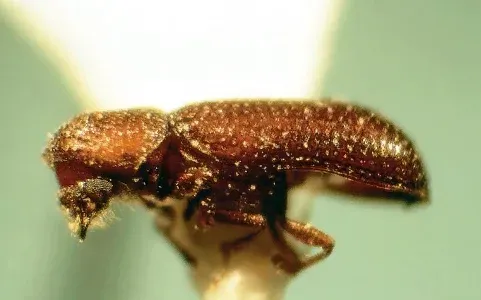
The bamboo borer (Dinoderus ocellaris) is a member of the Bostrichidae family. It is a small, cylindrical beetle, typically measuring 2.5 to 3.5 mm in length, with a dark brown to black coloration.
Its most distinct feature is the hood-shaped pronotum that covers its head. The anterior part of the pronotum is equipped with small, rasp-like teeth, which the beetle uses to bore into solid plant materials.
The larvae are white, C-shaped grubs with well-developed mandibles. These mandibles are specifically adapted for chewing through hardened plant tissues, such as dry bamboo culms or hardwoods.
Females lay their eggs in cracks, crevices, or pre-existing holes in the substrate. Once hatched, the larvae begin to penetrate the interior, where they remain throughout their development.
This pest is known for its cryptic lifestyle, making it difficult to detect until substantial damage to the structure or quality of the material has already occurred.
What it damages
Dinoderus ocellaris is a serious polyphagous pest that causes significant economic losses. It primarily infests stored bamboo, rattan, timber, and various starch-rich agricultural products.
The larvae bore complex networks of galleries inside the material. This internal destruction significantly reduces the structural integrity and aesthetic value of wooden and bamboo-based products.
Besides wood, the pest can attack stored dried crops, including cassava chips, grains, and other starch-containing items. Infested products are often contaminated with bore dust and larval waste.
Severe infestations often result in the complete destruction of materials, turning them into powdery debris. This renders the products useless for construction, furniture making, or food consumption.
In international trade, the presence of these beetles necessitates strict quarantine measures, as they are easily transported across borders through infested commodities.
When it appears
The bamboo borer thrives in warm, humid conditions. It is most prevalent in tropical and subtropical regions, but it can successfully infest materials in heated warehouses globally.
The optimal temperature for rapid development ranges from +25°C to +30°C. Under these conditions, the entire life cycle can be completed in as little as 4 to 6 weeks.
In temperate climates, the beetle is mostly active during the warmer months, unless stored in controlled environments. Development slows significantly in cooler conditions.
The spread of the beetle is closely linked to the logistics of bamboo and wood trade. High ambient humidity helps maintain the quality of the substrate for larval development.
Adult beetles are active and emerge to mate and find new breeding sites. Continuous infestation is common in warehouses where sanitation protocols are not rigorously followed.
Signs of infestation
The most reliable sign of an infestation is the appearance of small, round exit holes on the surface of the bamboo or wood. These holes indicate that adults have emerged from the galleries.
Fine, flour-like wood dust or frass found beneath the infested materials is a clear indicator of larval feeding activity occurring deep inside the product.
A loss of structural stability or unexpected breakage of bamboo items often occurs because the internal structure has been hollowed out by larval galleries.
In quiet environments, it is sometimes possible to hear a faint rasping or clicking sound produced by the larvae as they feed on the dense fibers of the wood.
Finding live adult beetles near stored products is a clear warning sign of an active infestation that requires an immediate and thorough inspection of the premises.
Control measures
Management of the bamboo borer requires an integrated approach focusing on prevention and physical intervention, as chemical control is often limited by the beetle's internal lifestyle.
- Fumigation of warehouse facilities and storage containers using appropriate gases.
- Heat treatment of timber or bamboo products (above +60°C) to kill all life stages.
- Use of light traps or pheromone traps for monitoring adult populations.
- Maintaining low humidity in storage areas to prevent further colonization.
- Regular sanitation to remove dust, debris, and infested material that could harbor the pest.
Quarantine and phytosanitary inspections are critical at entry points, particularly for imported bamboo handicrafts and construction materials, to prevent the introduction of new populations.
Applying contact insecticides to surfaces can help prevent adult beetles from boring into new materials, but this does not replace the need for thorough fumigation of already infested goods.
If an infestation is discovered, affected items should be promptly removed and destroyed or treated to ensure the pest does not spread to unaffected stock in the facility.
Taxonomy
- Latin name
- Dinoderus ocellaris
- Order
- Coleoptera (beetles)
- Family
- Bostrichidae
- EPPO code
- DINDOC
Discussion
No discussions yet — be the first.