
Bamboo borer
Dinoderus japonicus
Description
How to identify
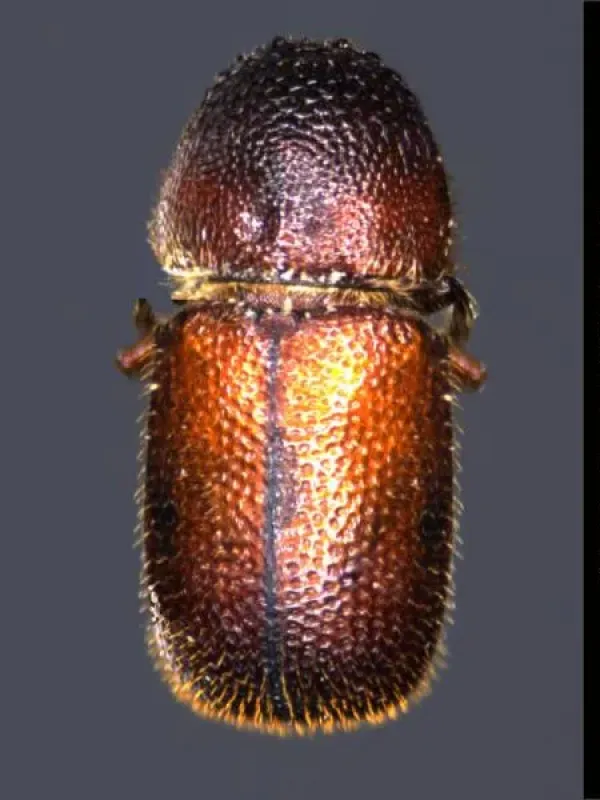
The bamboo borer (Dinoderus japonicus) belongs to the order Coleoptera and the family Bostrichidae. These beetles are small, typically measuring between 2.5 to 3.5 mm in length, and have a distinctive cylindrical body shape.
The adult beetle is dark brown or black. Its pronotum is robust, featuring small bumps and serrations at the front, creating a hood-like structure that obscures the head, which is a classic diagnostic feature of this family.
The larvae are white, C-shaped, and possess strong mandibles adapted for boring through dense plant tissues. They spend their entire developmental period inside the host material.
The life cycle is highly dependent on environmental conditions. Higher temperatures (25–30°C) and moderate to high humidity are ideal for rapid development and reproduction, allowing multiple generations per year.
Adults are strong flyers, enabling them to easily migrate to new food sources, including harvested bamboo stockpiles, furniture, and wooden warehouse infrastructure.
What it damages
This pest primarily attacks dry plant materials high in starch, with a strong preference for bamboo, rattan, and soft hardwoods. It is a major economic threat to the bamboo industry worldwide.
In addition to raw bamboo, it can infest finished products, including flooring, furniture, and handicrafts, causing significant aesthetic and structural damage that renders products unsellable.
Agriculture-related storage can also be affected, as the beetle may infest stored dried grains or pulses if conditions are favourable for its establishment.
The damage is caused by both adults boring into the material to lay eggs and larvae tunneling extensively through the internal tissues, effectively hollowing out the host.
Structural integrity is severely compromised as the internal fibers are converted into fine powder, leaving only a thin outer shell of the original material.
Signs of infestation
The most visible sign of an infestation is the presence of tiny, perfectly round exit holes on the surface of the bamboo or wood. These are created by adults emerging from the interior.
Accumulation of fine, flour-like wood dust (frass) beneath the infested items is a clear indication of active larval feeding and boring activity occurring inside the wood.
During a heavy infestation, faint rasping or clicking sounds may be heard from the wood, caused by larvae chewing through the dense fibers within the material.
In advanced cases, the material may feel spongy or brittle to the touch, and it may crumble under slight pressure, indicating extensive internal destruction.
The presence of adult beetles, particularly in the vicinity of stockpiles, confirms an active infestation that requires immediate intervention.
Control measures
Moisture management is a critical preventive measure. Keeping bamboo and wood products dry and properly ventilated significantly reduces the risk of infestation by this beetle.
Heat treatment is highly effective. Exposing infested materials to temperatures above 60°C for a sufficient period ensures the total mortality of all life stages of the beetle.
Chemical control, such as fumigation or treatment with residual insecticides, is necessary for large-scale storage facilities to prevent population buildup and cross-contamination.
Proper sanitation practices, including the regular removal of wood debris and dust from storage areas, help minimize nesting sites for the bamboo borer.
- Implementing strict quarantine checks on imported raw timber and bamboo.
- Using insect-proof mesh on storage facility vents to block flight access.
- Applying protective coatings or wood preservatives to finished bamboo goods.
Taxonomy
- Latin name
- Dinoderus japonicus
- Order
- Coleoptera (beetles)
- Family
- Bostrichidae
- EPPO code
- DINDJA
Discussion
No discussions yet — be the first.