
Bamboo borer
Dinoderus brevis
Description
How to identify
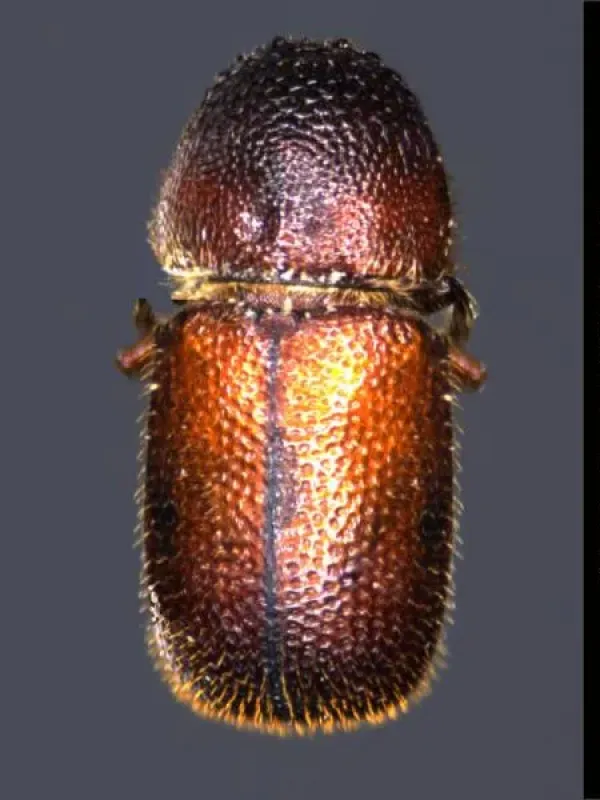
The bamboo borer (Dinoderus brevis) is a member of the Bostrichidae family within the order Coleoptera. This small beetle is characterized by its cylindrical shape and typical body size of 2.5 to 3.5 mm.
The adult beetle exhibits a reddish-brown to dark brown or black coloration. Its most prominent feature is the hood-like pronotum that obscures the head when viewed from above.
Larvae of this species are creamy-white, C-shaped, and possess well-developed legs. Their mandibles are specifically adapted for boring into dense wood and bamboo fibers.
This beetle is widely distributed globally, primarily due to international trade of bamboo and timber products, as it thrives in tropical and subtropical environments.
The lifecycle depends heavily on environmental conditions, with optimal reproduction occurring at temperatures ranging from 25 to 30 degrees Celsius and high humidity levels.
What it damages
This pest primarily attacks bamboo, rattan, and various types of timber. It causes significant economic losses in the wood processing, construction, and furniture industries.
While bamboo is its primary host, the beetle can also infest stored grains or processed food products if stored in the vicinity of infested timber materials.
Both adults and larvae are responsible for the damage. Larvae tunnel extensively through the material, effectively turning the interior into fine dust while leaving the outer shell relatively intact until structural failure occurs.
The infestation significantly weakens the mechanical properties of wood, rendering furniture, building materials, and decorative items completely useless.
Severe infestations can lead to the total collapse of bamboo structures, as the interior is consumed by successive generations of the beetle.
Signs of infestation
The most visible sign of an infestation is the presence of numerous small, circular exit holes on the surface of the timber or bamboo, measuring approximately 1-1.5 mm in diameter.
Below the infested items, you will often find piles of fine boring dust, which is pushed out by the larvae while they excavate their galleries inside the material.
In quiet environments, one might hear a faint scratching or rasping sound produced by the larvae as they feed on the internal fibers of the infested wood.
When pressure is applied to the surface of infested bamboo, it may feel soft or collapse, indicating that the internal structure has been destroyed by tunneling.
Adult beetles are often observed in warehouse environments during evening hours, attracted to light or seeking new surfaces for oviposition.
Control measures
Effective control starts with sanitation: maintaining dry storage conditions and removing all wood debris and scrap from the warehouse environment reduces attractant levels.
Fumigation of storage facilities with approved pesticides is the primary method for eliminating established populations, as it can reach deep into the infested timber.
Heat treatment is a highly recommended non-chemical control method, ensuring that all life stages (eggs, larvae, pupae) are killed before the product enters the supply chain.
Applying protective surface coatings, such as lacquers or chemical preservatives, helps create a barrier against adult beetles attempting to lay eggs on the wood surface.
- Regular inspections of incoming timber shipments.
- Isolating infested goods to prevent cross-contamination.
- Using pheromone or light traps to monitor adult beetle activity.
Taxonomy
- Latin name
- Dinoderus brevis
- Order
- Coleoptera (beetles)
- Family
- Bostrichidae
- EPPO code
- DINDBR
Discussion
No discussions yet — be the first.