
Palm borer
Dinapate wrightii
Description
How to identify
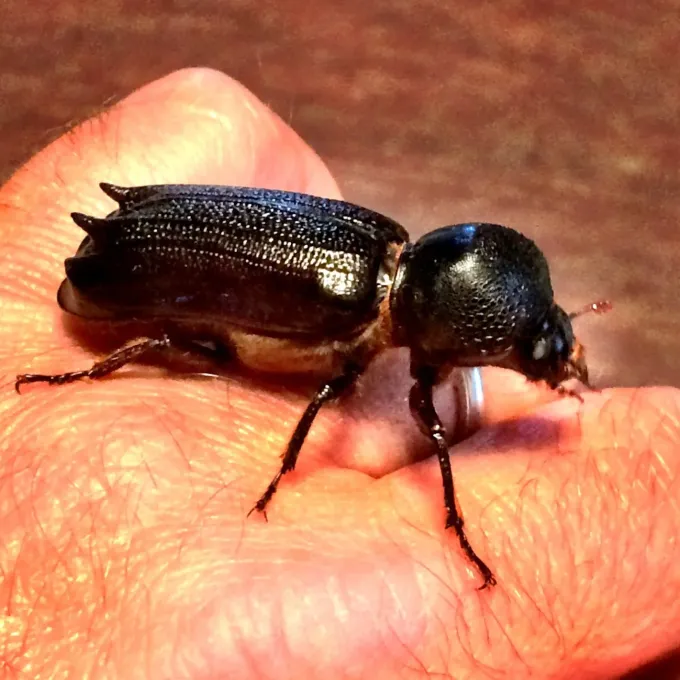
The palm borer (Dinapate wrightii) is a large beetle belonging to the Bostrichidae family. The adult beetle reaches a length of up to 50 mm, featuring a cylindrical, dark-colored body with a rough, bumpy pronotum.
The larvae of this species are creamy-white, curved, and possess strong mandibles adapted for burrowing through dense palm wood. Pupation typically occurs within the wood, inside specialized cells constructed by the mature larvae.
Adults are rarely seen as they spend most of their lives concealed within the host plant. They are primarily nocturnal or active in low-light conditions, further complicating their detection.
The lifecycle of Dinapate wrightii is remarkably long, ranging from three to five years. This extended development period makes the pest extremely difficult to eradicate once it has established itself.
As a highly specialized pest, the palm borer has evolved to efficiently digest the structural tissues of palm trees, particularly those of the Washingtonia species. Their biology is perfectly tuned to the life cycle of their hosts.
What it damages
The primary target of the palm borer is the California fan palm (Washingtonia filifera). The insect prefers older or stressed palms but can attack healthy trees if the environmental conditions are favorable.
Damage is caused by larvae mining deep tunnels within the palm trunk. These galleries disrupt the vascular tissues, preventing the transport of water and essential nutrients throughout the tree.
Severe infestations usually result in the destruction of the apical meristem (the growth point). Once this area is compromised, the palm loses its ability to produce new foliage and inevitably dies.
Structural damage is a significant concern, as the hollowed-out trunks become weak and prone to snapping or collapsing. This poses a major safety risk in populated park areas or residential landscapes.
The economic impact is particularly severe in nurseries and high-value botanical collections. Losing a mature, long-lived palm tree represents years of investment and significant aesthetic loss.
Signs of infestation
The most distinctive sign of an infestation is the presence of circular exit holes, approximately 6–8 mm in diameter, found on the surface of the trunk. These indicate that adult beetles have emerged.
Piles of wood shavings and frass around the base of the palm indicate that larvae are actively feeding inside. This accumulation is a clear sign that the internal structure is being destroyed.
Crown dieback is a common symptom of advanced infestation. As the internal water flow is interrupted, leaves begin to yellow, wilt, and dry out, starting from the center of the crown.
A hollow sound when tapping the trunk or unusual vibrations can suggest the presence of large internal cavities. Acoustic sensors are sometimes employed in professional settings to detect feeding activity.
The presence of dead adult beetles at the base of the tree is a final indication of an completed generation. If such evidence is found, the tree is likely heavily compromised and requires immediate inspection.
Control measures
Managing palm borers is notoriously difficult because the larvae remain protected deep within the trunk. Standard contact insecticides are ineffective against stages living inside the wood.
Preventive maintenance is the most successful management strategy. Keeping palm trees well-watered, properly fertilized, and free from unnecessary mechanical wounds significantly enhances their natural resistance.
Sanitation is critical; heavily infested trees should be felled and removed promptly. The infested wood must be chipped and destroyed or burned to prevent the adult beetles from emerging and migrating to nearby healthy palms.
Pheromone traps can be used to monitor adult flight patterns and population densities. Reducing the adult population before they lay eggs is the only way to effectively lower future infestation rates.
Professional arborists should perform regular inspections of high-value palm trees to identify early signs of entry holes. Early detection remains the best defense against this persistent and destructive wood-boring pest.
Taxonomy
- Latin name
- Dinapate wrightii
- Order
- Coleoptera (beetles)
- Family
- Bostrichidae
- EPPO code
- DINAWR
Discussion
No discussions yet — be the first.