
Dinapate
Dinapate
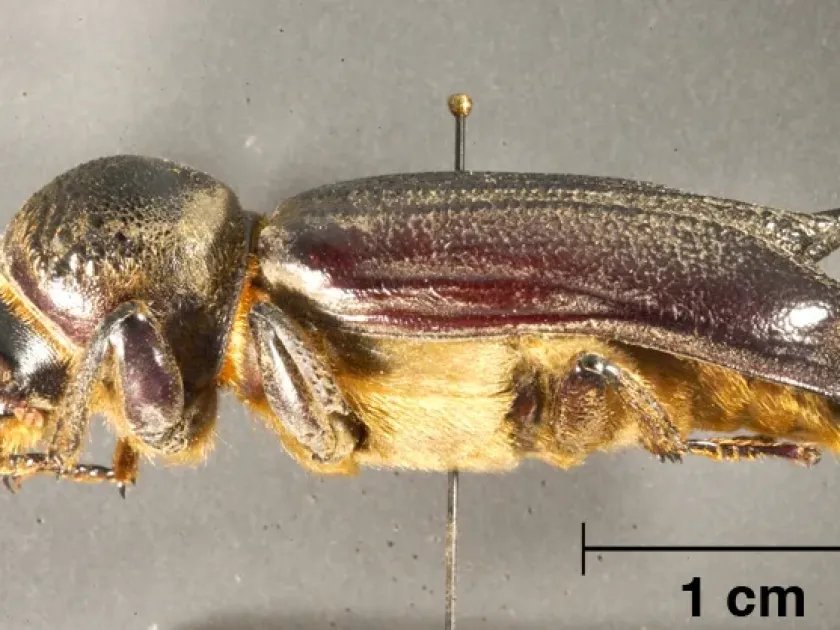
Description
How to identify
The Dinapate (most notably Dinapate wrightii) is a member of the Bostrichidae family, belonging to the order Coleoptera. It is a large wood-boring beetle known for its ability to devastate palm trees.
Adult beetles are robust, cylindrical insects with dark brown or black coloration, possessing a hard exoskeleton adapted for tunneling through dense organic matter.
The larvae are typically creamy white, curved, and heavily sclerotized at the head, providing the necessary strength to consume fibrous palm wood efficiently.
This species has an exceptionally long life cycle, with larvae spending several years developing inside the trunk before emerging as adults.
During the mating season, females seek out suitable palm trunks, often targeting stressed or decaying trees to lay their eggs in bark crevices.
What it damages
The primary hosts of the Dinapate beetle are various species of palm trees, including those in the Washingtonia and Phoenix genera, particularly in arid climates.
Larval feeding activity creates extensive galleries within the trunk, which physically destroys the vascular bundles responsible for water and nutrient transport.
Severe infestations often result in the total death of the tree, as the internal structural integrity is compromised, leading to canopy wilting and collapse.
The pest poses a significant threat to ornamental landscaping and palm plantations, as it can quickly spread from a single infested tree to an entire stand.
Damage is often cumulative, meaning the tree may harbor a large population of larvae for years before showing visible symptoms of decline.
Signs of infestation
Visible signs of an infestation include small, perfectly round exit holes appearing on the trunk surface, left behind by emerging adult beetles.
Frass (a mixture of excrement and wood shavings) accumulating at the base of the tree is a classic diagnostic feature indicating active internal feeding.
A yellowing and thinning canopy is a strong indicator of advanced internal damage, where the tree is struggling to maintain its physiological functions.
Sounding or tapping the trunk might reveal hollow areas, signaling that the inner wood has been significantly converted into galleries by the developing larvae.
In extreme cases, the palm trunk may exhibit physical instability, leaning or snapping due to the extensive destruction of its internal support tissues.
Control measures
Managing Dinapate is notoriously difficult because the larvae are hidden deep within the trunk, protected from most topical insecticide treatments.
The most effective management approach is strict sanitation: infested trees should be removed and destroyed immediately to break the beetle's life cycle.
Preventative care, including maintaining optimal tree health, is crucial, as Dinapate beetles are more likely to attack palms experiencing drought or other stresses.
Systemic insecticides may provide limited protection for surrounding healthy trees during the peak flight season of adult beetles.
- Routine inspection of palm trunks for exit holes.
- Immediate disposal of all infested wood materials.
- Pheromone monitoring to track adult beetle activity.
Taxonomy
- Latin name
- Dinapate
- Order
- Coleoptera (beetles)
- Family
- Bostrichidae
- EPPO code
- DINASP
Discussion
No discussions yet — be the first.