
Hooked powderpost beetle
Bostrychopsis uncinata
Description
How to identify
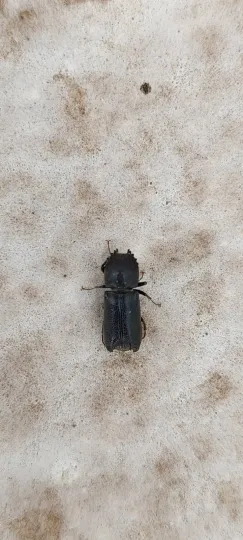
The hooked powderpost beetle (Bostrychopsis uncinata) is a member of the family Bostrichidae, order Coleoptera. These beetles are characterized by their cylindrical body shape and a hood-like pronotum that partially obscures the head when viewed from above.
Adult beetles typically measure between 4 and 7 millimeters in length. Their coloration ranges from reddish-brown to almost black, with the surface covered in fine punctures and sometimes sparse, short hairs.
A defining characteristic of this species is the presence of specific teeth and protuberances on the pronotum and elytra, which assist the insects in boring through dense woody substrates.
The life cycle involves complete metamorphosis: egg, larva, pupa, and adult. The insect spends the majority of its life cycle embedded within the wood, which serves as both its primary habitat and food source.
Accurate identification of this species often requires microscopic examination of morphological features, as many members of the Bostrichidae family share a similar general appearance.
What it damages
Bostrychopsis uncinata primarily feeds on the wood of both deciduous and coniferous trees. In nature, it most frequently infests weakened or recently felled trees, targeting the sapwood and deeper structural layers.
In human applications, this pest poses a significant threat to lumber, wooden structures, furniture frames, and dried timber products. It is capable of infesting wood with low moisture content.
Larvae create intricate, winding galleries within the wood, gradually compromising its structural integrity. This leads to reduced load-bearing capacity and severe damage to the aesthetic quality of the timber.
This pest is particularly hazardous in lumber storage facilities, where, if environmental conditions are not strictly managed, it can multiply rapidly and destroy large quantities of stock.
In addition to direct mechanical damage, the tunnels created by the beetles facilitate the entry of fungal spores, accelerating internal decay processes in the wood.
Signs of infestation
The most prominent sign of infestation is the appearance of small, perfectly round exit holes, approximately 2 to 3 millimeters in diameter, on the surface of the affected wood.
Fine wood dust, known as frass, is often found accumulating beneath these holes. Its color typically corresponds to the species of the timber being consumed by the larvae.
In quiet environments, during active infestation, a faint dry crunching or scraping sound caused by the larvae feeding inside the wood may sometimes be audible.
Loss of structural strength is a late-stage indicator of infestation, suggesting that an extensive network of larval galleries has already compromised the wood from within.
The presence of adult beetles on the surface of wooden materials during the spring and summer months serves as a clear indication that a breeding colony is present.
Control measures
The primary defense against this pest is rigorous moisture control, ensuring that only kiln-dried lumber is used in construction and woodworking applications.
Effective preventive measures include deep pressure treatment of timber with residual insecticides and wood preservatives that deter adults from laying eggs on the surface.
If signs of beetle activity are detected, it is crucial to isolate the affected components immediately to prevent the infestation from spreading to healthy wooden structures.
For existing infestations, fumigation with specialized gaseous pesticides is often necessary, as these chemicals can penetrate deeply into the larval galleries.
In residential settings, localized control can be achieved by injecting insecticidal solutions directly into the exit holes, followed by sealing these holes to ensure the chemical reaches the larvae.
Taxonomy
- Latin name
- Bostrychopsis uncinata
- Order
- Coleoptera (beetles)
- Family
- Bostrichidae
- EPPO code
- BOSYUN
Discussion
No discussions yet — be the first.