
Jesuit borer
Bostrychopsis jesuita
Description
How to identify
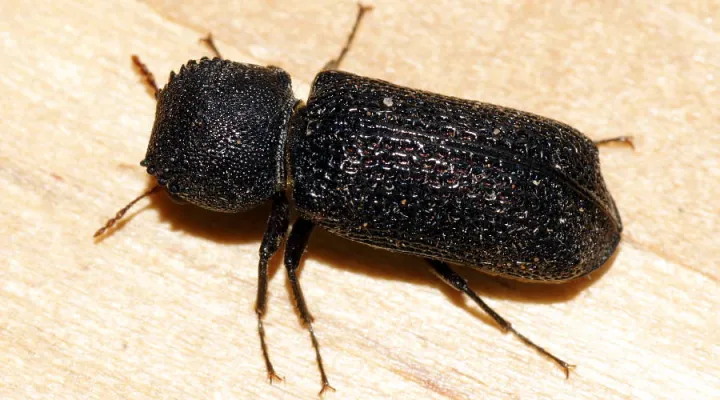
The Jesuit borer (Bostrychopsis jesuita) is a large wood-boring beetle belonging to the family Bostrichidae. Adults are typically 10 to 15 mm long with a cylindrical body and a dark brown or blackish appearance.
The most distinctive feature is the pronotum, which curves downwards over the head like a hood, giving the beetle its characteristic name. The surface of this pronotum is covered with rough tubercles and sharp spines.
Larvae are white, curved, and heavily sclerotized, adapted to burrowing through dense wood. They spend their entire developmental period inside galleries they carve within the timber or living tree trunks.
As a member of the order Coleoptera, this beetle possesses powerful mandibles designed for excavating wood fibers. Its antennae terminate in a three-segmented club, a key feature for taxonomic classification.
The life cycle involves a complete metamorphosis. Adults are strong fliers, allowing them to disperse effectively across orchards or forest stands to locate susceptible host plants for egg-laying.
What it damages
This beetle attacks a wide variety of hardwood species. Known hosts include eucalyptus, various fruit trees such as apple and pear, and citrus species, causing significant stress to the host plant.
Beyond living trees, the Jesuit borer is a notorious pest of seasoned timber. It frequently infests furniture, floorboards, building supports, and other wooden structures within indoor environments.
The primary damage is caused by the larvae, which bore extensive, irregular tunnels through the sapwood. This destroys the structural integrity of the wood and can eventually lead to complete decay.
In orchards, infestation of weakened or drought-stressed trees results in branch dieback or total tree death as the vascular tissues are severed by the beetle's tunneling activities.
In the timber industry, this species is considered a major quarantine pest, as it can be easily transported across borders through contaminated wood products, posing a threat to local forests.
Signs of infestation
The most visible sign of an infestation is the presence of perfectly round exit holes, about 3-4 mm in diameter, created by adults emerging from the wood surface.
Fine, powdery frass (wood dust) accumulates beneath the site of infestation. This material is a byproduct of the larvae feeding inside the wood and is a clear indicator of active tunneling.
Affected trees often show symptoms of decline, such as yellowing leaves, premature leaf drop, and dieback of the crown, caused by the disruption of water and nutrient transport.
A hollow sound when tapping the wood suggests internal gallery formation. In quiet environments, one may occasionally hear the faint clicking or crunching sounds of larvae at work.
For furniture or structural timber, the appearance of small piles of dust on the floor or surface is often the first indicator that a Jesuit borer infestation has taken root.
Control measures
Effective control starts with the sanitation of the infested area. Removing and burning dead or dying wood prevents the emergence of adults and the subsequent spread of the population.
To protect structural timber, apply deep-penetrating insecticides or wood preservatives. These treatments act as a barrier, preventing females from successfully laying eggs on the surface.
Maintaining tree vigor through consistent irrigation and proper fertilization helps trees resist borer attacks. Healthy trees can better withstand or seal off small localized infestations.
In indoor settings, professional fumigation or localized chemical injection directly into the larval holes is required to eliminate an established colony.
- Regular inspections of wood piles and orchard trees for exit holes.
- Use of pheromone traps to monitor and reduce adult beetle populations.
- Heat treatment of lumber to ensure the death of all life stages of the pest.
Taxonomy
- Latin name
- Bostrychopsis jesuita
- Order
- Coleoptera (beetles)
- Family
- Bostrichidae
- EPPO code
- BOSYJE
Discussion
No discussions yet — be the first.