
Capuchin beetle
Bostrichus capucinus
Description
How to identify
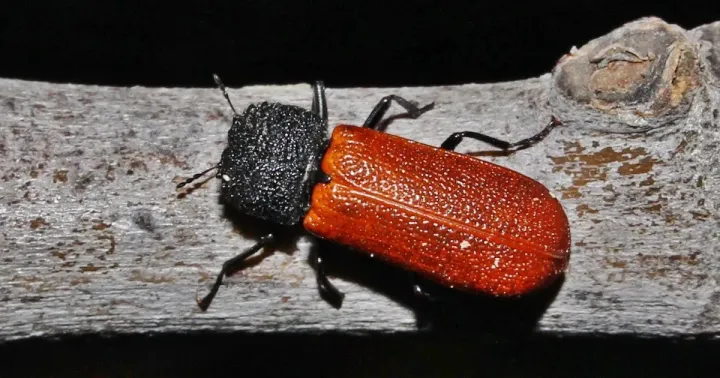
The Capuchin beetle (Bostrichus capucinus) is a member of the Bostrichidae family within the order Coleoptera. The adult beetle is characterized by its distinct, cylindrical body, which typically measures between 7 and 15 mm in length and features a striking red or dark brown coloration.
A primary diagnostic feature is the pronotum, which is strongly hooded and hides the head from view, giving the beetle a look reminiscent of a monk's cowl. The surface of the pronotum is textured with small tubercles and teeth, aiding the beetle's movement through galleries.
Larvae are typical of wood-boring beetles: they have a stout, curved, whitish body with a well-developed head and powerful mandibles specifically adapted for chewing through solid wood tissue.
As xylophages, these insects spend most of their life cycle protected within the wood, which complicates early detection and makes them significant pests in both forestry and wood storage facilities.
The life cycle undergoes complete metamorphosis, typically spanning one year under favorable climatic conditions. Development occurs entirely within the woody host, which serves as both food source and shelter.
What it damages
The Capuchin beetle primarily infests broad-leaved trees, including oak, beech, hornbeam, and birch. It tends to favor weakened, dying, or freshly felled timber, though it can occasionally attack seemingly healthy trees if the population pressure is high.
The primary damage is caused by both adults and larvae boring galleries into the bark and sapwood. This process disrupts the tree's vascular system, leading to branches drying out and potentially causing total tree mortality in severely infested cases.
This beetle is a serious pest for the timber industry, as it infests stored logs and processed wood. The numerous tunnels carved by the beetles compromise the structural integrity of the wood, making it unusable for construction or fine woodworking.
In orchards, the Capuchin beetle can damage the branches of fruit-bearing trees. While they prefer stressed specimens, their presence in nearby forest edges often serves as a source of recurring infestation for cultivated plants.
Economic damage is twofold: it involves both the loss of commercial timber value due to internal tunneling and the ecological impact on forest health by contributing to the decline of weakened stands.
When it appears
The activity period for adult beetles begins in late spring and continues throughout the summer months. During this time, they actively emerge to locate suitable host trees for mating and oviposition.
Peak activity is typically observed on warm, sunny days. Females chew small entrance holes through the bark to establish the breeding sites, which serve as the starting point for larval development galleries.
Larval development takes place during the summer and autumn. Throughout this period, the larvae consume wood continuously, growing in size and creating extensive, winding gallery systems deep within the host tissue.
Overwintering occurs as larvae or pupae within the wood. As temperatures rise in the spring, the insects resume activity, eventually completing their development into adults before emerging to begin a new generation.
Climate variables, particularly temperature and humidity, dictate the duration of the life cycle. Warmer seasons often result in more rapid development and increased damage intensity.
Signs of infestation
The most prominent sign of an infestation is the presence of small, perfectly circular entrance or exit holes on the surface of the bark or timber. These holes are typically about 2–3 mm in diameter.
Fine, wood-colored dust, known as frass, is often found accumulating beneath the exit holes or in crevices. This dust consists of chewed wood particles and excrement produced by the larvae and adults.
In forest stands, the sudden drying or dieback of branches, or the entire crown, often points to a significant infestation by xylophagous beetles, as the galleries disconnect the nutrient flow to these parts.
If a piece of infested wood is split, the internal gallery structure becomes visible, often packed with tightly compressed frass. This structural damage is irreversible and ruins the aesthetic and mechanical quality of the wood.
- Circular exit holes in bark or wood
- Accumulations of sawdust-like frass
- Dieback of twigs or branches
- Cracks and fissures appearing in the bark
- Presence of adult beetles during peak summer months
Control measures
Effective management begins with strict forest and orchard hygiene. The prompt removal and destruction of infested, dead, or dying trees prevent them from becoming breeding grounds for subsequent generations of beetles.
Timber storage practices are critical; logs should be stored in dry, well-ventilated areas, ideally away from forest edges, and elevated off the ground to minimize the attractiveness to the beetles.
For high-value timber or decorative structures, chemical treatments using contact and systemic insecticides can provide a protective barrier against beetle colonization and larval development.
In orchard management, maintaining tree vigor through proper irrigation and fertilization is essential, as healthy trees with strong sap flow are better equipped to resist successful beetle entry.
Monitoring the population density using specialized pheromone or light traps during the flight season allows for timely interventions, ensuring that control measures are applied before significant damage occurs.
Taxonomy
- Latin name
- Bostrichus capucinus
- Order
- Coleoptera (beetles)
- Family
- Bostrichidae
- EPPO code
- BOSTCA
Discussion
No discussions yet — be the first.