
Black borer
Apate monachus
Description
How to identify
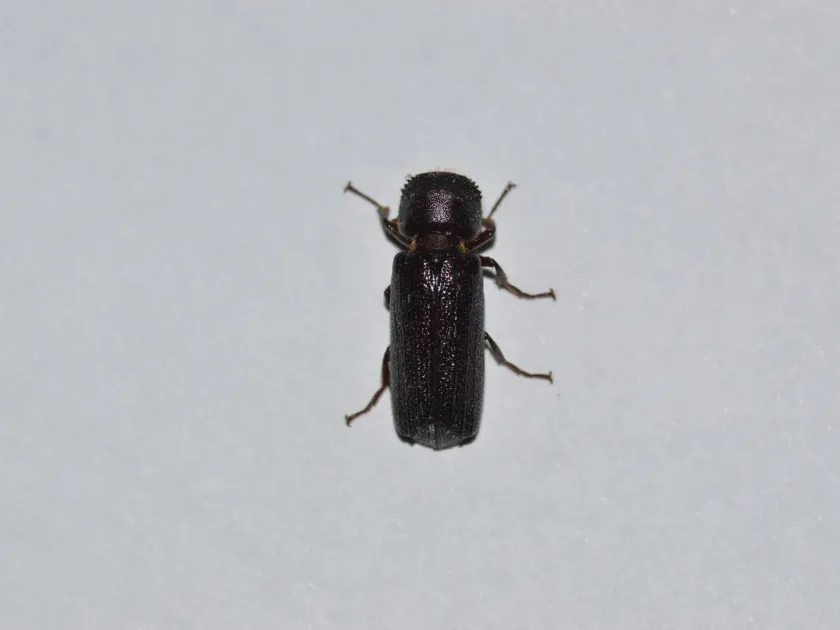
The black borer (Apate monachus) is a member of the Bostrichidae family, commonly known as auger beetles. These beetles are typically 10 to 15 mm in length.
Adult beetles have an elongated, cylindrical body covered in a hard, black or dark-brown exoskeleton. The surface of the elytra displays a distinct, rough, and pitted texture.
The most recognizable feature of the species is its pronotum, which is angled downwards, effectively covering the head like a hood, which is a signature trait of the family.
Larvae are white, grub-like creatures with a curved body, adapted for boring through wood. They remain deep inside the plant tissue, making them difficult to spot during routine checks.
The mandibles of these beetles are exceptionally strong, allowing them to tunnel through dense wood and even thin metal foils if they encounter them in storage or transport.
What it damages
This pest is a major polyphage, meaning it attacks a wide variety of tree and shrub species, posing a significant threat to both commercial orchards and ornamental landscapes.
Common host plants include pomegranates, citrus, figs, grapevines, coffee plants, and numerous hardwood forest species. It can also infest timber in storage.
Adult beetles bore into young shoots and larger branches to feed and mate, creating tunnels that weaken the structural integrity of the affected plant parts.
The tunnels created by the beetles disrupt nutrient transport and provide entry points for secondary pathogens, such as fungal and bacterial wood rot, which can kill the tree.
In nurseries, infestation of the main stem can ruin entire batches of young trees, leading to economic losses and requiring the removal and destruction of the infected plants.
Signs of infestation
The most obvious signs of infestation are perfectly round entry holes on the bark of stems and branches, often accompanied by piles of sawdust or wood shavings on the ground.
Exudation of sap or gum from the bark surface is a frequent reaction of the plant to the beetle's drilling activities, signaling an attempt to seal off the entry point.
Canopy thinning and sudden wilting of terminal shoots are indicators that the internal tunnel network has severely compromised the branch's ability to transport water.
Accumulation of fine, granular frass, which looks like coarse flour, around the base of the tree or on leaves directly beneath the entrance holes, confirms active infestation.
In cases of severe infestation, affected branches often become brittle and snap easily during wind events, exposing the internal gallery system carved out by the larvae.
Control measures
Sanitation is the most effective management strategy. All infested wood, especially branches showing signs of drilling, should be pruned immediately and burned to prevent spread.
For localized infestations on thick trunks, individual beetle galleries can be injected with appropriate systemic insecticides and then sealed with pruning paste to prevent re-entry.
The use of pheromone-baited traps or light traps during the adult beetle's emergence period helps monitor populations and can help reduce the number of mating individuals.
Applying protective insecticide sprays on the trunks and main branches during peak flight periods provides a chemical barrier that deters beetles from settling on the trees.
Maintaining optimal tree vigor through balanced fertilization and correct irrigation is crucial, as healthier trees are better at resisting and recovering from minor pest attacks.
Taxonomy
- Latin name
- Apate monachus
- Order
- Coleoptera (beetles)
- Family
- Bostrichidae
- EPPO code
- APATMO
Discussion
No discussions yet — be the first.