
Horned powder-post beetle
Amphicerus cornutus
Description
How to identify
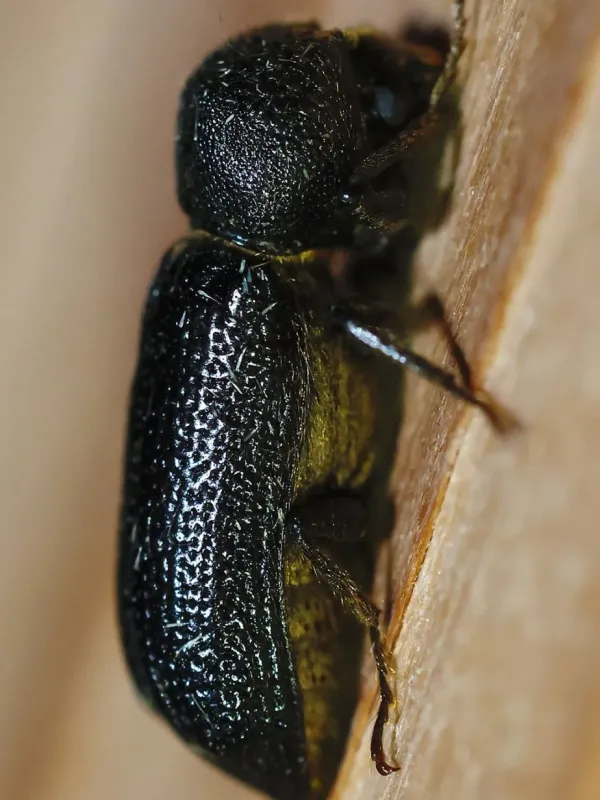
The Horned powder-post beetle (Amphicerus cornutus) belongs to the Bostrichidae family within the order Coleoptera. Adult beetles are typically 10–15 mm long and have a cylindrical, dark brown or black body.
A distinctive feature of this beetle is the highly developed pronotum, which acts like a hood covering the head. Males have noticeable horn-like projections on this pronotum, which is the primary trait for identification.
Larvae are white, curved, and possess a well-developed head adapted for boring through wood. They spend their entire life cycle hidden within woody tissues, making visual detection of larvae nearly impossible until damage appears.
Adult beetles are strong fliers and exhibit high activity during the summer months. This ability allows them to spread rapidly throughout orchards, nurseries, and forested areas, seeking out stressed host trees.
The life cycle usually spans one to two years, depending on environmental temperatures and the health of the host wood. Pupation occurs within the tunnels carved by the larvae inside the tree branches or stems.
What it damages
This pest primarily attacks stressed deciduous and fruit trees. Vulnerable hosts include grapevines, apple, pear, fig trees, and various ornamental shrubs that have been weakened by environmental factors.
Adult beetles cause damage by boring into the bases of young shoots. This feeding behavior weakens the structure of the branches, leading to premature wilting and breakage during moderate winds or heavy foliage loads.
Larvae create extensive tunnel systems deep inside branches and trunks, which disrupts the tree’s vascular system. Prolonged infestation leads to reduced sap flow, resulting in dieback and potential death of the entire plant.
Plants suffering from drought, mechanical injury, or existing diseases are significantly more attractive to this beetle. A healthy tree with high vigor can often resist initial attacks through sap pressure and resin production.
Economic losses include diminished fruit yields, the labor costs associated with removing damaged wood, and the replacement of trees that succumb to structural failure caused by the boring tunnels.
Signs of infestation
One of the most obvious signs of infestation is the presence of tiny, circular exit holes on the surface of branches and bark. These holes are the points where adult beetles emerged from the wood.
Fine, sawdust-like material, often called "frass" or "boring dust," is frequently observed accumulating near the exit holes or in the crotches of branches, indicating active wood consumption by the pest.
Sudden wilting and drooping of new shoot tips during the summer suggest adult beetle activity at the base of these shoots. Affected shoots are usually brittle and break easily at the point of damage.
Bark cracking and the gradual dieback of specific sections of the crown are long-term indicators of deep larval infestation. As the galleries expand, the structural integrity of the wood is compromised significantly.
Orchard managers can monitor for the presence of the beetle using pheromone lures or by performing detailed inspections of thin-barked branches, particularly during periods of intense heat and dry weather.
Control measures
Cultural control is the most effective strategy, specifically the immediate pruning and destruction of infested branches. Burning the infected wood prevents the emergence of the next generation of beetles.
Maintaining high orchard hygiene and ensuring proper irrigation are crucial for tree vigor. Healthy trees are better equipped to defend themselves against the Horned powder-post beetle through physical barriers.
Chemical control may be required in high-pressure areas, focusing on systemic insecticides applied during the peak flight period of adult beetles to prevent them from boring into the succulent new growth.
Biological control, using natural predators or entomopathogenic fungi, can be integrated into management programs to keep the beetle population below the economic injury level without excessive pesticide use.
- Conduct routine health checks on all fruit trees and shrubs.
- Seal large pruning wounds to prevent entry points for beetles.
- Remove stumps and dead wood that act as breeding reservoirs.
Taxonomy
- Latin name
- Amphicerus cornutus
- Order
- Coleoptera (beetles)
- Family
- Bostrichidae
- EPPO code
- AMPICO
Discussion
No discussions yet — be the first.