
Lead cable borer
Amphicerus bicaudatus
Description
How to identify
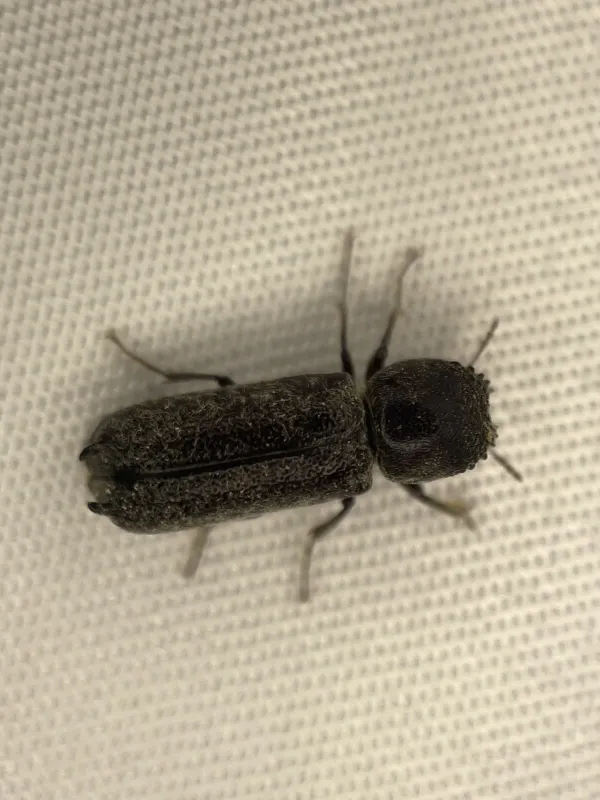
The lead cable borer (Amphicerus bicaudatus) is a wood-boring beetle belonging to the family Bostrichidae within the order Coleoptera. Adult beetles are cylindrical in shape, typically 10–12 mm long, and dark brown to black in color.
The name "hood" or "cap" refers to the pronotum, which is strongly curved forward, effectively hiding the head from above. Male beetles feature two prominent thorn-like projections at the tip of the abdomen, aiding in identification.
The larvae are C-shaped, legless grubs with a whitish body. They reside deep within the wood, which makes them invisible during much of their development cycle.
Adult beetles are strong fliers and are known to be attracted to light sources at night. This behavior is often observed by growers and can be used for monitoring purposes.
These insects prefer to infest stressed or weakened wood, where they create intricate tunnel systems for both feeding and egg-laying purposes.
What it damages
Both adults and larvae are responsible for the damage. Adult beetles bore into healthy shoots and buds of grapevines, often causing the terminal parts of the vines to wilt and eventually die.
Beyond grapevines, this pest has a broad host range, damaging various fruit trees such as apple, pear, and plum, as well as several ornamental and forest tree species.
Larvae feed within the woody tissue of stems and branches. This internal boring disrupts the vascular system, significantly weakening the plant and potentially leading to the death of entire canes or limbs.
The damage is most severe in drought-stressed plants, as these are more susceptible to successful colonization by the beetles.
Infestation can reduce overall plant vigor, resulting in lower yields and increased vulnerability to secondary infections and diseases.
When it appears
The adult flight period generally occurs in late spring and throughout the summer months, during which beetles migrate to find suitable hosts.
The life cycle can range from one to several years depending on the climate and the specific host plant conditions. Pupation occurs inside the wood tunnels created by the larvae.
New adults emerge from the wood to feed on succulent young shoots before searching for mating partners, which is a critical stage for pest control.
The peak activity often aligns with the rapid growth phase of the vine, making the vineyard highly susceptible during these months.
Overwintering typically takes place in the larval stage within the woody host, providing protection from harsh environmental conditions and predators.
Signs of infestation
One of the most apparent signs of infestation is the presence of small, circular holes on the surface of the bark, often accompanied by piles of sawdust or "frass" at the base.
Sudden wilting and browning of vine tips during the growing season are indicative of beetles boring into the base of the shoots, effectively pruning them.
Physical inspection of the wood may reveal galleries stuffed with wood shavings, which are the byproduct of the larvae feeding inside the branch.
- small holes in the bark of canes;
- sawdust deposits on the ground;
- sudden wilting of shoot tips;
- dieback of older woody canes.
When an infested branch is cut, the internal tunnel network created by the larvae becomes visible, often extending deep into the heartwood.
Control measures
Sanitation is the most effective management strategy; this includes the prompt removal and burning of all infested wood to eliminate the breeding population.
Maintaining vineyard health through proper irrigation and balanced fertilization ensures that plants remain vigorous and less attractive to the beetle.
Chemical control can be difficult due to the concealed nature of the pest. Applications must be timed precisely to target the adults during their emergence phase.
Systemic insecticides may provide some level of control against larvae, provided they are applied in accordance with regional regulations and pre-harvest intervals.
Integrated Pest Management (IPM) practices, such as monitoring flight activity and maintaining orchard hygiene, are essential to minimize the impact of the lead cable borer.
Taxonomy
- Latin name
- Amphicerus bicaudatus
- Order
- Coleoptera (beetles)
- Family
- Bostrichidae
- EPPO code
- AMPIBI
Discussion
No discussions yet — be the first.