
Clover seed weevil
Squamapion cineraceum
Description
How to identify
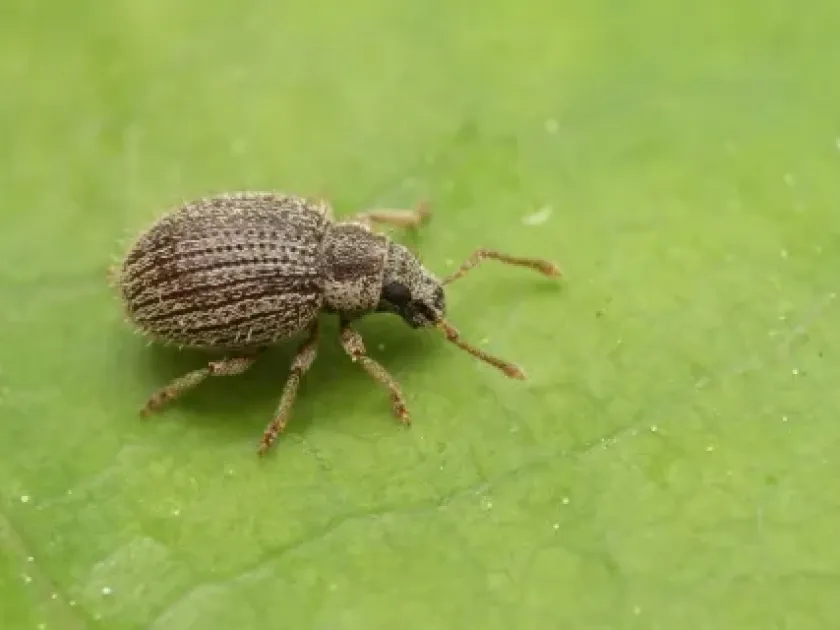
The clover seed weevil (Latin: Squamapion cineraceum) is a member of the Apionidae family within the order Coleoptera. These are small beetles, typically measuring between 2.0 and 2.5 mm in length.
The adult insect has an elongated, oval body, which is black with a metallic sheen. Its surface is covered with dense grey hairs, giving it an ash-grey appearance. They possess a long, slender snout characteristic of the weevil group.
The larvae are legless, white, and have a distinct brown head capsule. They spend their entire developmental phase feeding inside the reproductive parts of the clover plant.
This species completes one generation per year. Adults hibernate in the soil, under plant debris, or in woodland litter, emerging in early spring as temperatures rise.
These beetles are highly active during warm, sunny days, which facilitates their movement across fields to locate blooming clover plants for feeding and oviposition.
What it damages
The primary hosts for the clover seed weevil are various species of clover, especially red clover. Both adults and larvae cause damage, although the larvae are responsible for the most significant economic losses.
Adult beetles feed on leaves and flower buds by creating small circular holes, which weakens the plant's vigor and reduces the effectiveness of photosynthesis.
The larvae represent the most destructive stage, as they tunnel into the clover florets and consume the developing seeds within the seed pods.
A single pod may contain one or several larvae, which can hollow out the seeds completely, leaving behind only excrement and debris, thus rendering the seed crop unmarketable.
Premature shriveling and browning of clover heads are common outcomes of larval activity, leading to a substantial decrease in seed yield and overall quality.
When it appears
Emergence from overwintering sites typically begins in early spring when temperatures reach 10–12°C. At this stage, they begin feeding on the foliage of new clover growth.
The most intense infestation occurs during the clover budding and flowering stage. During this time, the beetles mate and females prepare to lay eggs within the flower heads.
Oviposition occurs throughout the flowering period, with females depositing single eggs directly into the ovary of the clover flower using their snouts.
Larval development takes approximately 2–3 weeks, during which they feed continuously on the seed material. Pupation takes place inside the damaged clover head.
New adults emerge in mid-to-late summer, feed briefly on remaining plant tissues, and eventually seek out protected areas to enter diapause for the winter.
Signs of infestation
Early signs of infestation include the appearance of numerous small pin-prick holes on the clover leaflets, which are indicative of adult beetle feeding activity.
A key field symptom is the premature browning and drying of flower heads, which often appear distorted or feel hollow when gently squeezed.
Upon inspecting a clover head, growers can find white, legless larvae inside the florets, accompanied by destroyed seed remnants and dark fecal pellets.
Uneven ripening and a patchy appearance across the field can suggest localized infestations of the seed weevil, as damaged areas fail to develop normally.
A significant reduction in the weight of harvested seed compared to healthy stands is a clear indicator that the seed weevil population has exceeded the economic threshold.
Control measures
Effective crop rotation is a primary preventative measure, ensuring that clover is not planted in the same field for multiple consecutive years to disrupt the pest cycle.
Deep plowing following the harvest of clover seed fields helps bury overwintering beetles, significantly reducing the population pressure for the subsequent growing season.
Maintaining proper spatial isolation between new clover plantings and old, infested fields prevents the early spring migration of adult weevils.
Chemical control involving systemic or contact insecticides may be necessary during the late bud stage, ensuring that applications are scheduled to avoid harming pollinators.
Integrated Pest Management (IPM) practices, including the use of pest-resistant varieties and optimizing harvest timing, are essential for maintaining sustainable yields.
Taxonomy
- Latin name
- Squamapion cineraceum
- Order
- Coleoptera (beetles)
- Family
- Apionidae
- EPPO code
- SQAPCI
Discussion
No discussions yet — be the first.