
Squamapion
Squamapion
Description
How to identify
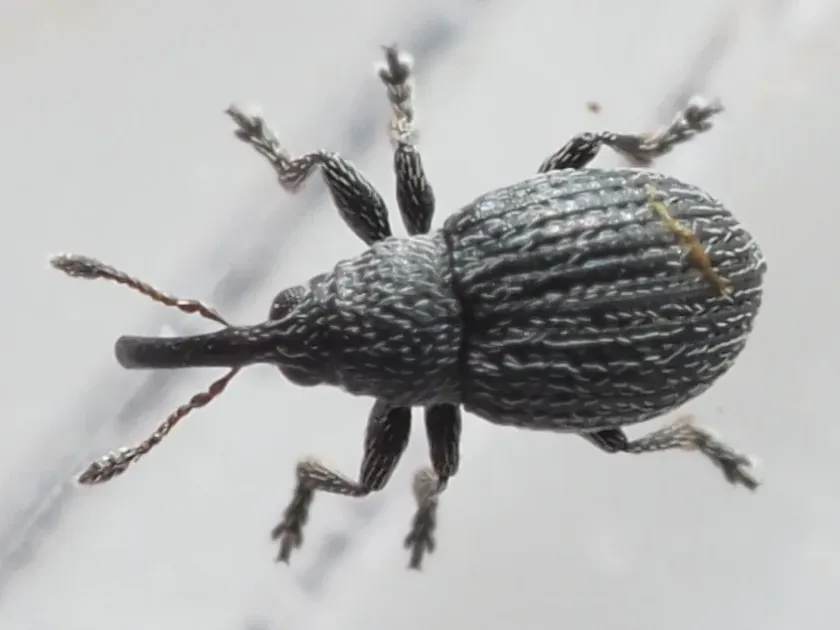
Squamapion is a genus of weevils belonging to the family Curculionidae. These insects are characterized by their small body size, typically pear-shaped structure, and a distinct elongated rostrum (snout) typical of this family.
The adult beetles usually exhibit a dark coloration, ranging from deep brown to black. Their bodies are often covered with fine scales, which can give them a matte or slightly glossy appearance under magnification.
Adults possess functional wings, allowing for significant migration across fields in search of host plants. Precise species-level identification is complex and often requires microscopic examination of structural traits.
The larvae are typical of weevils: legless, cream-colored, and slightly curved. Their head capsules are clearly defined and usually feature a darker pigmentation than the rest of their body.
Because the larvae develop internally within the plant's generative organs, they remain invisible from the surface until significant tissue damage has already occurred, making early detection a challenge.
What it damages
The primary hosts for various species of Squamapion are legumes. They cause the most notable economic damage to clover crops and various wild pulse species used in forage production.
Adults feed on young leaves and developing buds, creating small circular holes. This feeding behavior weakens the plants, reduces photosynthetic efficiency, and impairs overall development during the growing season.
However, the most severe damage is caused by larvae that feed within flower heads or developing seed pods. They consume the internal contents of seeds, leading to a substantial reduction in yield and quality.
Infested flower heads often appear deformed, wither prematurely, or fail to produce viable seeds. This is particularly devastating for seed production fields where the final yield is the primary objective.
In cases of high pest density, seed losses can be significant, necessitating rigorous monitoring and timely intervention during the critical budding stage of the crops.
When it appears
Squamapion activity begins in the spring as soon as temperatures become consistently warm. Adult beetles emerge from their overwintering sites, which typically include the top layer of soil or plant debris.
The peak period of adult flight and feeding coincides with the budding phase of legume crops. This is the period when beetles are most active and susceptible to management interventions.
Females deposit eggs directly into the developing flowers. The larvae develop throughout the summer months, with their growth rate being highly dependent on ambient temperature and environmental conditions.
By late summer, the new generation completes its development and seeks suitable environments for diapause. This ensures the survival of the population even through harsh winter conditions.
Depending on the region's climate and the duration of the warm season, there may be one or two generations per year, which directly impacts the severity of infestations.
Signs of infestation
The first signs of infestation are small, multiple perforations or "shot holes" on the leaves, caused by adult beetle feeding. These are early warning signals that the pest population is present in the field.
Deformed or unevenly developed flower heads are indicators of internal larval feeding. Opening a suspect bud often reveals larval waste or the larvae themselves hidden inside the damaged tissues.
Unexpected shedding of immature seed pods or delayed maturation of flower spikes can also point to high larval density within the field, requiring immediate inspection.
Agronomists often use sweep nets in the early morning to estimate adult population density. This is the most reliable method for determining whether the economic threshold for chemical treatment has been reached.
Other symptoms include general plant stunting and localized drying of the canopy, which often occurs after the larvae have already caused irreversible damage to the crop's reproductive capacity.
Control measures
Effective management of Squamapion involves a combination of agronomic practices and targeted insecticide use. The goal is to interrupt the pest's life cycle before it can cause significant yield loss.
Crop rotation is a critical preventive measure, as planting legumes far from previous infestation sites significantly limits the ability of the beetles to find host plants after winter.
Chemical control should be applied based on economic thresholds. Applications should ideally be timed during the budding phase, taking care to minimize impact on beneficial pollinators by avoiding spraying during full bloom.
- Deep autumn plowing to bury overwintering sites and reduce the next year's population.
- Use of systemic insecticides when budding is at its peak.
- Removal of weed reservoirs that host the pests around crop perimeters.
- Selection of resistant or early-maturing legume varieties.
- Regular field scouting to detect infestation early.
Biological control agents, including entomopathogenic fungi, are increasingly used in integrated pest management programs, providing a sustainable way to suppress population growth without heavy reliance on synthetic pesticides.
Taxonomy
- Latin name
- Squamapion
- Order
- Coleoptera (beetles)
- Family
- Apionidae
- EPPO code
- SQAPSP
Discussion
No discussions yet — be the first.