
Sweet potato weevil
Cylas puncticollis
Description
How to identify
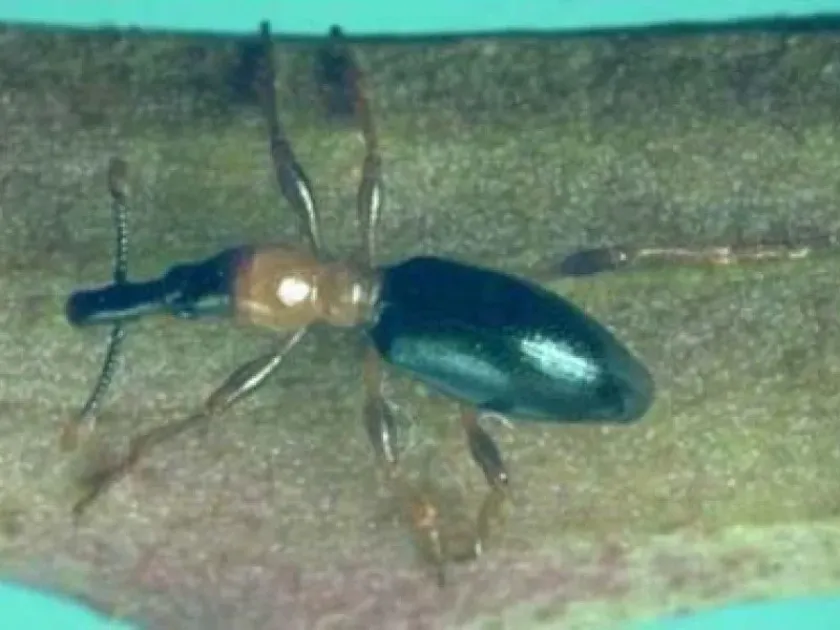
The sweet potato weevil (Cylas puncticollis) is a destructive coleopteran insect belonging to the Brentidae family. Adults are easily recognized by their elongated, ant-like appearance and a glossy black or dark brown metallic body.
The insect possesses a distinctive elongated snout (rostrum) and elbowed antennae. The elytra are marked with clear punctations, which is a key identification feature. The insect is highly adapted to life on its host plant, showing minimal migration between fields.
Eggs are small, oval, and deposited singly by females into shallow cavities carved into the stem or tubers. The larval stage is characterized by a cream-colored, legless body with a distinct dark head capsule, feeding entirely within the plant tissue.
The pupation stage takes place inside a specialized chamber within the host plant, protecting the developing insect from external environmental factors. This internal developmental cycle makes it highly resilient to traditional surface pesticide applications.
As a specialist feeder, Cylas puncticollis relies on the sweet potato plant for all its nutritional and reproductive needs, causing substantial economic losses in the tropical regions where it is endemic.
What it damages
The sweet potato plant (Ipomoea batatas) is the primary host. The pest damages both stems and storage roots (tubers). Stem infestation leads to stunted growth and wilting, while tuber damage makes them completely unmarketable.
The larvae tunnel through the tuber, leaving galleries filled with frass. The physical destruction of the tissue is coupled with a chemical response from the plant, producing terpenes that give the potatoes a bitter taste and foul odor.
Secondary infections of fungi and bacteria often enter through the tunnels created by the weevil, leading to the rapid decay of the stored crop. This significantly reduces the post-harvest shelf life of the produce.
Severe infestations can destroy a large portion of the yield in the field. When tubers are harvested already containing larvae, the weevils continue to breed in storage, potentially destroying the entire inventory.
The economic impact is high, as even light infestations can render a crop unacceptable for consumer markets due to the unpleasant taste and visible damage to the tuber surface.
When it appears
The life cycle of the sweet potato weevil is strongly influenced by temperature and moisture. Warm and dry conditions significantly accelerate its reproductive rate, allowing for the rapid completion of multiple generations per season.
In tropical climates, the pest can breed continuously throughout the year if host plants are present. There is no traditional diapause period unless host availability is limited by harsh seasonal changes.
Infestation pressure increases significantly during the tuber enlargement phase. As tubers grow, they become more attractive for oviposition, and larvae can penetrate deeper into the developing roots.
The developmental period from egg to adult is generally between 30 to 45 days. This quick life cycle allows populations to build up rapidly if not monitored and managed from the onset of the planting season.
The beginning of the infestation is often triggered by planting infested stem cuttings, which acts as the primary vector for spreading the weevil across new cultivation areas.
Signs of infestation
The earliest signs of infestation are small circular holes on the stems near the soil line, indicating that adult weevils have emerged from their internal galleries. Visible feeding marks on the leaves and stems are also early indicators.
Tubers infested by larvae may show surface deformities, cracks, or hardened bumps. These physical changes are often accompanied by the characteristic bitter scent of the damaged potato tissue.
Internal damage becomes apparent upon cutting open a tuber. The flesh is often riddled with dark tunnels and cavities filled with dark waste, and the surrounding tissue may show signs of decay.
General yellowing and wilting of the vines, despite sufficient soil moisture, are strong indicators that the stem tissue has been compromised by the larvae, hindering the plant's vascular function.
In stored tubers, the presence of adult weevils moving on the surface or the discovery of exit holes clearly signals that the stock has been infested and requires immediate disposal or separation.
Control measures
The most important control strategy is the use of pest-free planting materials. Quarantine checks and the treatment of cuttings before planting are essential to prevent the establishment of the pest in clean fields.
Crop rotation is vital. Sweet potatoes should not be planted on the same land more often than once every 3–4 years. Furthermore, sanitation involving the removal of all infested crop residues is crucial after harvest.
Hilling up the soil around the base of the plants acts as a mechanical barrier. This practice makes it more difficult for the female weevils to reach the tubers for egg-laying, thereby reducing the rate of infestation.
Early harvest is recommended as soon as the tubers reach maturity. Every week the tubers remain in the soil after reaching maturity increases the risk of higher levels of weevil infestation.
- Use pheromone traps to monitor adult population levels and mass-trap males to disrupt the mating cycle.
- Apply entomopathogenic fungi such as Beauveria bassiana to the soil to provide biological suppression.
- Eliminate wild Convolvulaceae weeds in the vicinity of the fields to remove alternative breeding sites.
- Store healthy tubers in cool, dry, and clean environments to prevent the spread of the pest during the post-harvest phase.
Taxonomy
- Latin name
- Cylas puncticollis
- Order
- Coleoptera (beetles)
- Family
- Apionidae
- EPPO code
- CYLAPU
Discussion
No discussions yet — be the first.