
Sweet potato weevil
Cylas formicarius
Description
How to identify
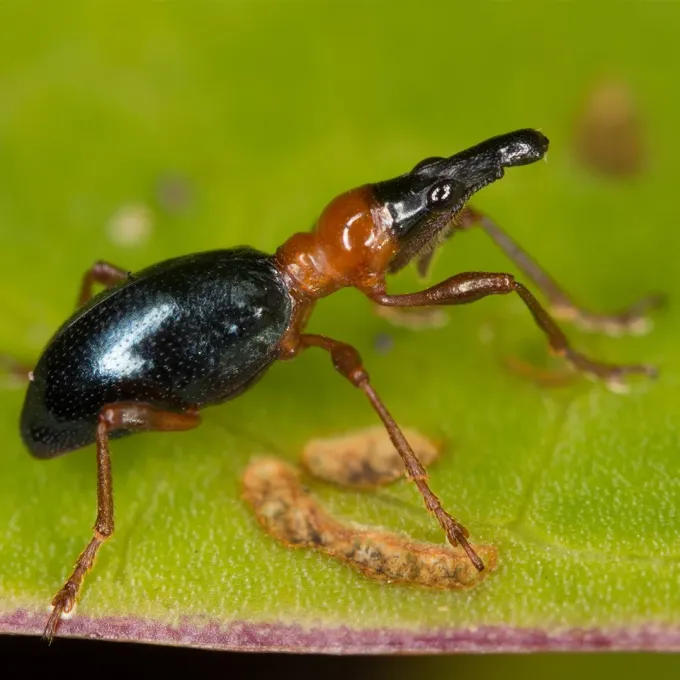
The sweet potato weevil (Cylas formicarius) is an insect belonging to the order Coleoptera and the family Brentidae. The adult beetle is characterized by a slender body that resembles an ant due to a constricted thorax and an elongated snout.
Adults are typically 5 to 8 mm long. They possess metallic blue-black elytra, while the head, legs, and thorax exhibit a distinctive reddish-brown or orange coloration, making them easily distinguishable from other storage pests.
The larvae are legless, cream-colored grubs with a well-developed brownish head capsule. They grow up to 8-9 mm in length and reside entirely within the plant tissue, feeding on the internal structures of the crop.
Pupation occurs within the tunnels made by the larvae inside the stems or tubers. The pupae have a free form and undergo a color shift from white to dark brown as they mature into adult beetles.
The life cycle of Cylas formicarius is highly dependent on environmental temperatures. In tropical and subtropical climates, the insect continues to breed throughout the year without entering true diapause, allowing for multiple generations.
What it damages
The sweet potato (Ipomoea batatas) is the primary host crop for this pest. In some instances, it may also infest other members of the Convolvulaceae family, including wild morning glory relatives.
While adult weevils feed on foliage and vines, the primary damage is caused by the larvae, which bore into the stems and, most critically, the tubers of the sweet potato plant.
The internal burrowing of the larvae creates a network of tunnels filled with frass, effectively destroying the interior of the root and rendering the sweet potato unfit for commercial sale or human consumption.
Secondary infections, such as bacterial or fungal rots, often follow larval feeding, leading to the rapid decay of the tubers, causing a foul odor and a bitter taste that makes the product completely inedible.
In cases of severe infestation, the sweet potato weevil can lead to yield losses exceeding 60-80%, representing a devastating economic impact for both small-scale farmers and large commercial operations.
Signs of infestation
The first external sign of an infestation is often the yellowing and wilting of the vines, which frequently mimics symptoms of water stress or nutrient deficiency, leading to delayed detection.
Upon closer inspection, small, circular emergence holes may be visible on the surface of the stems or the exposed portions of the tubers, indicating where adult weevils have bored out.
Cutting into a harvested tuber will reveal extensive tunnels filled with brownish, powdery excrement, which serves as a definitive diagnostic feature of sweet potato weevil damage.
Stunted plant growth and snapping of the vines at the base are common indicators that the larvae have compromised the structural integrity of the plant by feeding near the crown.
The production of terpenes, specifically ipomeamarone, in response to the insect's feeding, gives the damaged tuber a distinctively bitter, medicinal taste that is often the first warning sign during consumption.
Control measures
Effective management begins with strict crop rotation practices, avoiding sweet potato planting in the same field for at least 3-4 years, and maintaining spatial isolation from previous harvest sites.
The use of certified, weevil-free "slips" or planting material is the most critical preventative measure, as the pest is most frequently introduced to new fields via infested tubers or cuttings.
Cultural practices such as deep hilling (mounding) around the base of the plants help cover exposed tubers and create a physical barrier that prevents adult females from laying eggs near the roots.
Integrated Pest Management (IPM) strategies, including the deployment of pheromone traps, are essential for monitoring population levels and timing insecticide applications to target the most vulnerable stages of the adult beetle.
- Deep plowing immediately after harvest to destroy residual tubers and larvae.
- Eradication of wild host weeds within the Convolvulaceae family near the fields.
- Harvesting crops as early as possible to minimize the time for tuber infestation.
- Applying recommended systemic insecticides during the planting phase to provide initial protection.
Taxonomy
- Latin name
- Cylas formicarius
- Order
- Coleoptera (beetles)
- Family
- Apionidae
- EPPO code
- CYLAFE
Discussion
No discussions yet — be the first.