
Sweet potato weevil
Cylas
Description
How to identify
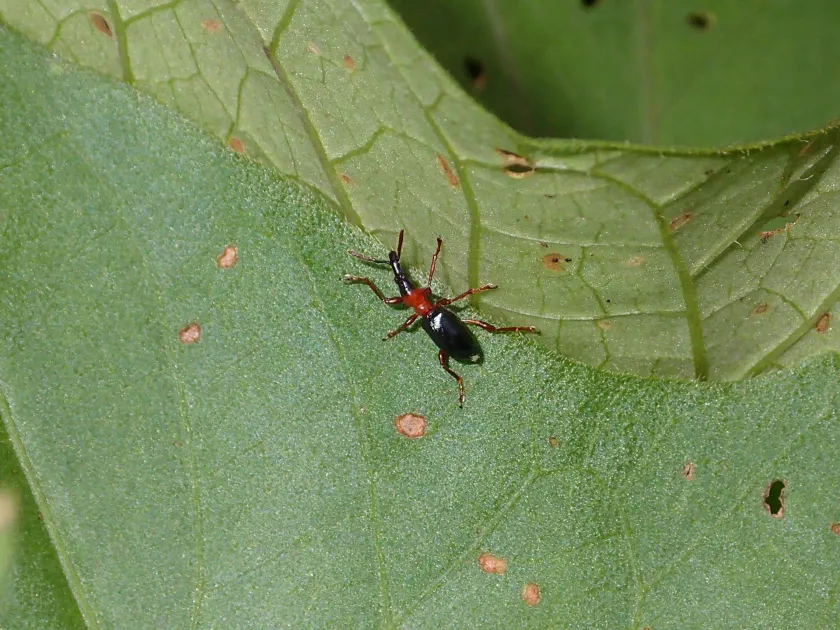
The sweet potato weevil (Cylas formicarius) is a notorious pest belonging to the family Brentidae. It is recognized by its distinct ant-like appearance, which makes it easily distinguishable from other typical weevils.
The adult insect has a shiny black to bluish-black body with reddish-brown legs and thorax. It typically measures between 6 to 8 millimeters in length and possesses a long, slender snout.
Females lay individual eggs in small cavities they create in the stems or tubers of the sweet potato plant. They seal these holes with a fecal plug, making the presence of eggs difficult to detect initially.
The larvae are legless, white, and have a brown head capsule. They develop exclusively within the plant tissues, spending their entire immature life cycle inside the vines or the sweet potato roots.
Pupation occurs within the feeding tunnels created by the larvae inside the tuber. Once the transformation is complete, the adult emerges by chewing its way out, leaving characteristic round exit holes.
What it damages
Larval feeding is the primary cause of damage, as they create extensive tunnels throughout the tuber. This feeding destroys the structure of the root and creates channels for decay.
Beyond physical destruction, the presence of the weevil triggers a chemical response in the plant. The roots produce terpenoids in reaction to the larvae, which render the sweet potatoes extremely bitter and inedible.
The tunnels created by larvae often become entry points for secondary pathogens, including bacteria and fungi, which lead to rapid rot and decay, rendering the harvest completely unsalable.
Adult weevils also cause minor damage by feeding on the leaves and stems of the plant. While less destructive than the larvae, heavy infestations can significantly weaken the foliage.
If not controlled, the sweet potato weevil can lead to total crop failure, with damage often manifesting during both the growing season in the field and the storage phase.
When it appears
The sweet potato weevil thrives in warm climates and is highly active during hot, dry weather. Development is fastest in temperatures ranging from 25°C to 30°C.
In tropical and subtropical regions, the pest can reproduce continuously throughout the year, with multiple overlapping generations occurring in a single season.
Infestation levels usually peak during the latter part of the growing season when tubers are enlarging. This is when the weevils are most attracted to the plant for egg-laying.
Migrations of adult weevils from infested fields to new, healthy crops are common in areas where sweet potatoes are grown continuously without a rest period.
Because they are protected inside the plant tissue for most of their life cycle, they are resilient to environmental fluctuations that might otherwise limit their population.
Signs of infestation
Visible wilting or yellowing of the vines, particularly near the base of the plant, is often the first indicator of a severe infestation within the stems or root zone.
The presence of round exit holes on the surface of the tubers or stems indicates that adults have already emerged, confirming that a reproductive cycle has taken place.
Internally, infested tubers show darkened, tunneling tracks filled with fecal material. The texture of the tuber may become spongy or soft due to secondary rot.
A persistent, strong bitter taste when preparing the tubers is a clear sign that the plant has responded to weevil feeding, even if external damage appears minor.
- Stunted growth of vines.
- Presence of small holes on the tuber skin.
- Tunneling and fecal matter inside the root.
- Presence of adults under leaves or near the base of the plant.
Control measures
The use of clean, certified planting material is the most important preventive measure. Avoiding the introduction of weevil-infested tubers into new areas is crucial.
Crop rotation is highly effective. By planting sweet potatoes in fields where they have not been grown for at least three to four years, you can significantly reduce the local population pressure.
Hilling (earthing up) is a vital cultural practice. Adding extra soil around the base of the plant fills in cracks in the earth that the female weevils use to access the tubers for egg-laying.
Pheromone traps are essential for monitoring the presence of adult males. They help in determining the timing for insecticide applications if chemical intervention is necessary.
Sanitation after harvest is mandatory. Destroying all infested crop residues, including cull tubers and vines, prevents the population from surviving and infesting the next season's crop.
Taxonomy
- Latin name
- Cylas
- Order
- Coleoptera (beetles)
- Family
- Apionidae
- EPPO code
- CYLASP
Discussion
No discussions yet — be the first.