
Clover seed weevil
Apion voisini
Description
How to identify
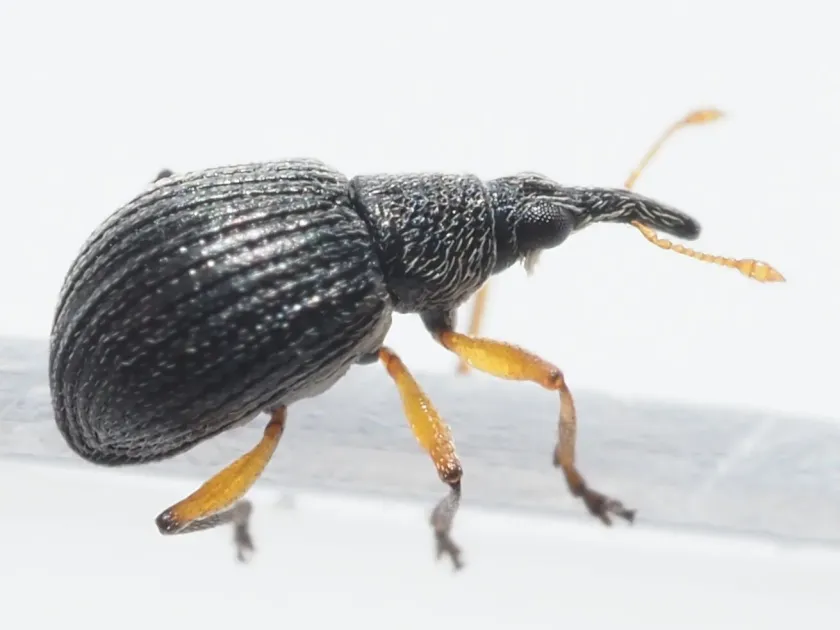
The clover seed weevil (Apion voisini) is a small beetle belonging to the family Brentidae (formerly Apionidae), order Coleoptera. It is a highly specialized pest known for its pear-shaped body and elongated rostrum.
Adult beetles are typically 2–3 mm long, with a dark blue or black coloration that often exhibits a metallic sheen. Their physical appearance is perfectly adapted for navigating the dense foliage of legume crops.
The larvae are legless, C-shaped grubs with a pale, whitish body and a darker head capsule. They are strictly endophagous, meaning they live and feed entirely within the seed pods of their host plants.
Adults overwinter in protected areas such as soil cracks, leaf litter, or nearby hedgerows. They emerge during the spring once temperatures consistently exceed the threshold required for their activity.
Recognizing the adult beetle early in the season is critical for management, as they are responsible for laying eggs in the newly forming flowers of the clover.
What it damages
The primary economic damage is caused by the larvae, which burrow into the ovary of the clover flower and consume the developing seeds. This directly reduces the seed yield and quality.
Adults also feed on leaves and flower buds by making small punctures. While this feeding damage is usually minor, severe infestations can stunt plant growth and reduce overall vigor.
A single larva can consume an entire seed within the pod, leading to a significant loss in seed viability and germination rates, which is detrimental for seed production farms.
Heavy infestations can result in up to 50% or more yield loss if left unchecked. Damaged heads often wither prematurely and fail to produce viable seed stocks.
The pest is most destructive during the reproductive phase of the clover, as the synchronization between the weevil's life cycle and the plant's flowering period is nearly perfect.
When it appears
Activity begins in early spring, typically when air temperatures reach 10–12°C. Adults migrate from hibernation sites to young clover fields to feed and mate.
Egg-laying occurs during the budding and early flowering stages. The female uses her rostrum to pierce the flower base and insert her eggs directly into the developing seed structure.
Larval development occurs within the flower head and lasts approximately 2–3 weeks. After the larval stage, pupation takes place inside the seed pod or the flower itself.
New generation adults emerge in mid-summer, coinciding with the maturation of clover seeds. This timing allows them to complete their life cycle before preparing for winter.
Depending on the climatic conditions of the region, the weevil may produce one or two generations per season, increasing the risk of re-infestation in late-maturing crops.
Signs of infestation
Early season scouting should focus on leaves showing small, circular punctures, which indicate the presence of adult beetles feeding on the foliage.
During the flowering stage, yellowing or premature wilting of individual florets within the flower head is a clear sign that larvae are active inside the seed structure.
If you observe a high number of hollow or malformed seed pods during inspection, it is a definitive indicator of a significant infestation that requires immediate intervention.
Using a sweep net in the field during sunny weather is an effective method to monitor adult populations and determine the necessity of control measures.
A lack of seed yield despite healthy-looking plants is often the result of hidden damage caused by larval feeding, making early detection through field scouting essential.
Control measures
Effective management requires an integrated approach that combines cultural practices, such as proper field rotation and spatial isolation, with targeted chemical treatments.
Early harvesting of the clover for hay can disrupt the life cycle of the weevil by removing the host material before the larvae complete their development and pupate.
Chemical control should be limited to the early budding stage, as this is the most vulnerable period for the pest, while simultaneously minimizing harm to essential pollinators like bees.
Deep plowing after the final harvest helps to bury crop residues and kill overwintering adults, significantly reducing the population pressure for the next season.
- Maintain distance between new and old clover fields to prevent migration.
- Select early-maturing cultivars to reduce the exposure window.
- Implement pheromone traps to track population spikes and time interventions accurately.
Taxonomy
- Latin name
- Apion voisini
- Order
- Coleoptera (beetles)
- Family
- Apionidae
- EPPO code
- APIOVN
Discussion
No discussions yet — be the first.