
Green clover weevil
Apion virens
Description
How to identify
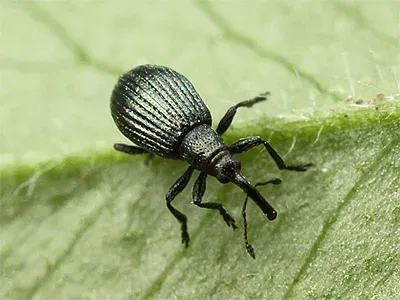
The green clover weevil (Apion virens) belongs to the Apionidae family, within the order Coleoptera. This small beetle is typically between 2 mm and 2.5 mm in length.
The body shape is distinctively pear-like, which is characteristic of the genus Apion, with a notably thin and elongated rostrum used for feeding and egg-laying.
The adult weevils are recognizable by their metallic green or bluish-green coloration, which creates a shimmering effect in the sunlight.
Larvae are legless, curved, and white in color with a brown head capsule, specialized for living and feeding inside plant tissues.
The pupal stage occurs within the plant, which serves as a protective environment against predators and some environmental stressors.
What it damages
The primary hosts for the green clover weevil are various species of clover (Trifolium), making it a significant pest in forage legume production.
Adults feed on the foliage, chewing small circular holes through the leaf blades, which reduces the total photosynthetic capacity of the plant.
Larval feeding is more destructive, as they burrow into stems, leaf stalks, and reproductive structures, causing physical damage to vascular tissues.
This internal damage interrupts the flow of water and nutrients, resulting in stunted growth, chlorosis, and reduced vigor of the clover stand.
High infestation levels significantly decrease both the biomass yield and the seed production potential of the affected fields.
When it appears
Adults overwinter in the soil, under plant debris, or within the leaf litter of clover fields, remaining dormant during the winter months.
Emergence begins in the spring, triggered by rising temperatures, when adults start feeding on young clover leaves to gain energy for reproduction.
Mating and oviposition occur throughout the late spring and summer, with females carefully depositing eggs into the plant tissues.
The new generation of adults typically emerges in mid-to-late summer, continuing to feed until autumn temperatures prompt them to seek shelter for the winter.
There is usually one generation per year, though variations in climate can lead to differences in the timing of the insect life cycle.
Signs of infestation
The most visible sign of an infestation is the presence of numerous small holes in the clover leaves, often referred to as shot-holes.
Stems may show signs of swelling or deformation as a result of larval tunneling, which can be observed during close field inspections.
Infested plants often display patches of yellowing (chlorosis) and are more prone to wilting during hot and dry weather conditions.
Flowers and seed heads may appear shriveled or fail to develop properly, leading to a noticeable reduction in the overall seed yield.
A general decline in the quality and density of the clover stand is a clear indicator that the pest population has reached an economic threshold.
Control measures
Effective management begins with sound agronomic practices, such as maintaining proper crop rotation and preventing overlapping of old and new clover stands.
Timely mowing of the clover for hay is one of the most effective methods to disrupt the lifecycle, as it removes larvae that are still developing inside the stems.
Deep autumn plowing of the harvested fields helps to reduce the survival rate of overwintering adults by burying them in the soil.
In cases of severe outbreaks, targeted insecticide applications may be necessary during the bud development stage to protect the seed crop.
- Strategic timing of harvesting and mowing.
- Spatial separation of clover fields.
- Removal of wild legume weeds from field margins.
- Regular monitoring of adult populations in spring.
Taxonomy
- Latin name
- Apion virens
- Order
- Coleoptera (beetles)
- Family
- Apionidae
- EPPO code
- APIOVI
Discussion
No discussions yet — be the first.