
Sweet clover seed weevil
Apion meliloti
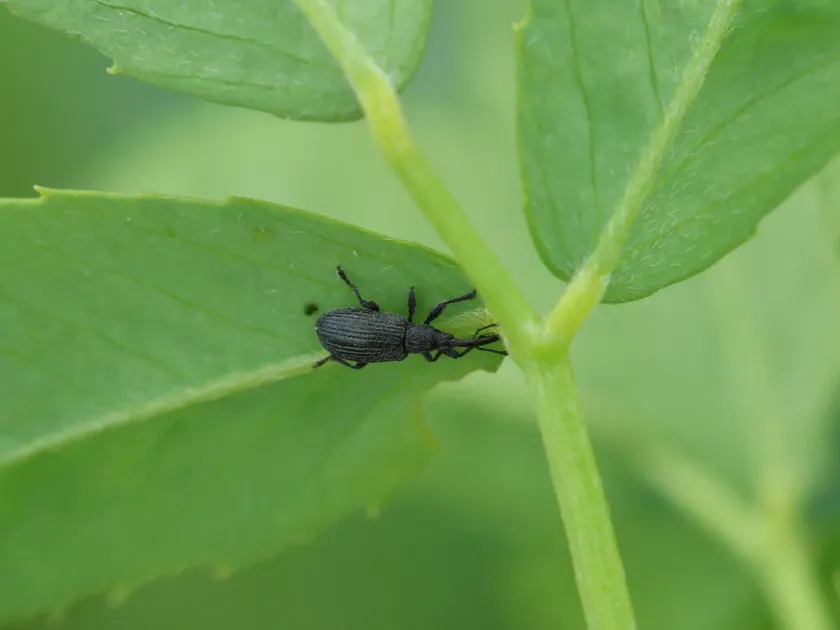
Description
How to identify
The sweet clover seed weevil (Apion meliloti) is a small beetle belonging to the Apionidae family, known for its specific host range among legumes.
Adult insects are typically 2 to 3 mm long with a distinct pear-shaped body, dark coloration, and a fine, dense pubescence covering their exoskeleton.
A key identifying feature is the long, slender rostrum (snout) which is essential for feeding on generative plant organs and depositing eggs.
Larvae are small, legless, creamy-white grubs with a dark sclerotized head, specifically adapted for life and feeding inside a single seed.
These beetles are widely distributed in temperate zones where sweet clover (Melilotus) is grown for forage, green manure, or seed production.
What it damages
The primary crop damaged by this species is sweet clover, although it may occasionally affect other closely related leguminous plants.
Adult weevils cause damage by feeding on young buds and flowers, often resulting in flower abortion and reduced pod set in the early season.
The most severe economic damage is caused by the larvae, which bore into the developing pods and consume the interior of the seeds.
Infestation leads to a significant decrease in seed yield, weight, and overall germination quality, which is critical for seed-producing farms.
In cases of high pest pressure, seed losses can be devastating, sometimes exceeding 50% of the harvest if no protection measures are taken.
When it appears
Adults overwinter in the soil or under leaf litter, emerging in early spring when ambient temperatures remain consistently above 12–15°C.
They begin their activity by feeding on the foliage and budding shoots of host plants, preparing for the upcoming reproductive phase.
Oviposition occurs from late spring through early summer, corresponding with the development of the first green pods on the clover plants.
The larval stage is spent entirely inside the seed pods, where the insect grows and eventually undergoes pupation within the same pod.
A new generation of adults emerges in late summer, feeds briefly on host vegetation, and then seeks overwintering sites as temperatures drop.
Signs of infestation
Visible signs of infestation include small, uniform circular holes in buds and petals caused by adult feeding activity early in the season.
Pods may show premature yellowing or abnormal shriveling, indicating that the seeds inside have been consumed or damaged by larvae.
Dissecting the pods reveals the presence of white larvae, frass (excrement), and hollowed-out seeds, confirming the presence of Apion meliloti.
Premature pod drop or a high percentage of light, undersized seeds during harvest are strong indicators of a significant infestation level.
Monitoring fields during the flowering period will often reveal the presence of adult beetles, especially when using an insect sweep net.
Control measures
Cultural control strategies include deep autumn plowing to bury overwintering adults and destroy their habitat before they emerge in the spring.
Establishing spatial isolation between new sweet clover fields and older stands is effective in preventing the spread of the weevil.
Harvesting the crop as early as possible after maturity can help reduce the number of emerging new-generation adults left in the field.
Chemical control involving approved insecticides may be necessary during the bud stage if economic injury levels are exceeded.
- Crop rotation with non-leguminous plants.
- Eliminating wild sweet clover reservoirs near agricultural fields.
- Regular scouting of fields during the flowering stage.
Taxonomy
- Latin name
- Apion meliloti
- Order
- Coleoptera (beetles)
- Family
- Apionidae
- EPPO code
- APIOME
Discussion
No discussions yet — be the first.