
Broom seed beetle
Apion fuscirostre
Description
How to identify
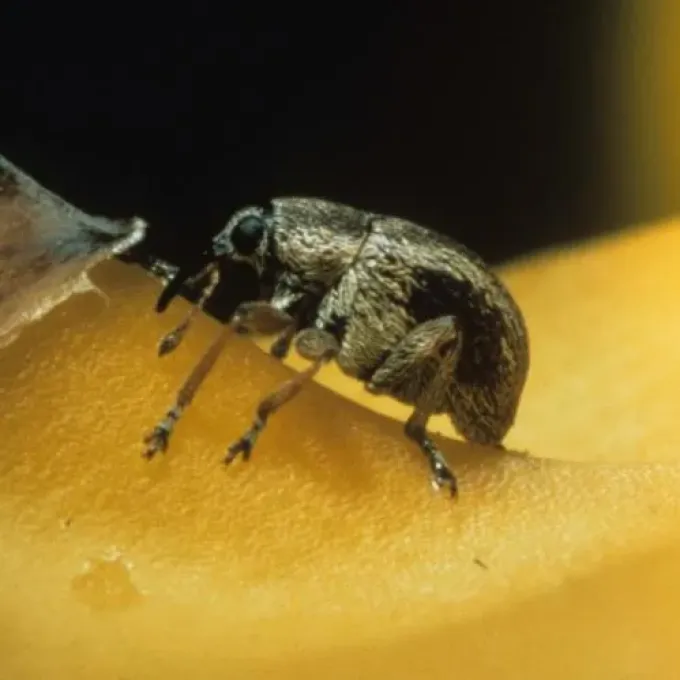
The broom seed beetle (Apion fuscirostre) is a small insect belonging to the family Apionidae. The adult beetle is typically 2.5–3 mm long and is characterized by a long, slender rostrum (snout) that curves downwards.
The body is generally black, covered with sparse greyish or white hairs, giving it a dull appearance. The elytra are rounded with distinct longitudinal grooves, which is a key diagnostic feature for identification.
The larvae are legless, C-shaped, and creamy-white in color, with a dark, sclerotized head capsule. They are specialized for life within the seeds of leguminous plants, particularly those of the Cytisus genus.
The lifecycle involves complete metamorphosis: egg, larva, pupa, and adult. Each stage is tightly synchronized with the development of the host plant, ensuring that larvae have a consistent food source.
Adult beetles are capable of flight, allowing them to disperse effectively across landscapes to locate suitable host plants for oviposition, especially during the flowering season of broom shrubs.
What it damages
The primary host of this pest is the common broom (Cytisus scoparius). The beetles feed on both vegetative and reproductive structures, causing varying degrees of damage throughout the growing season.
Adults consume young buds and leaves, creating numerous small, shot-like holes. While this rarely kills mature shrubs, it can significantly weaken young plants and reduce their aesthetic value.
The most severe damage is caused by the larvae, which burrow into the seed pods and consume the developing seeds. This leads to the destruction of the embryo and the total loss of seed viability.
Affected pods may become deformed, wither prematurely, and fall off. This damage hampers the natural regeneration of the shrub and creates significant issues for commercial nurseries growing broom seeds.
In cases of high infestation, a large percentage of the seed crop can be destroyed, negatively impacting the ecological role of the broom shrub within its habitat.
When it appears
The beetles overwinter as adults in the soil, under plant debris, or in bark crevices. They emerge in the spring, typically from April to May, when temperatures rise and host plants begin to bud.
Mating and egg-laying occur during the flowering period of the broom. The female uses her rostrum to drill a hole into a developing pod and deposits an egg, protecting it within the pod tissues.
Larval development takes place throughout the summer. The larvae feed on the interior contents of the seeds and eventually pupate within the shell of the seed pod, emerging as adults in mid-to-late summer.
The new generation of adults feeds briefly before seeking suitable sites for winter hibernation. This single generation per year is typical for this species in temperate climates.
Environmental conditions, particularly moisture levels during the formation of pods, play a critical role in the survival rate of the larvae and the subsequent population size for the following year.
Signs of infestation
The most visible sign of an early spring infestation is the presence of small holes in the foliage and flower buds, indicating that adults are feeding on the plant tissue.
During the pod development stage, one might observe small dark puncture marks on the pods, which are the sites where eggs were deposited by the female beetles.
If an infested pod is opened, one can find the larvae, empty seed coats, or a frass-filled interior, which often leads to rotting tissues inside the pod that would otherwise be healthy.
Premature pod drop is another significant indicator. If pods fall to the ground while they are still green or before maturity, it is often a sign that the seeds inside have been consumed by larvae.
Surveys using sweep nets during the flowering period can confirm the presence of adult beetles, allowing for timely intervention if the infestation density exceeds the threshold for economic damage.
Control measures
Cultural control is essential. This includes the collection and destruction of infested pods and fallen plant material, which prevents larvae from completing their life cycle and emerging as adults.
Soil management, such as tilling the soil around the base of the shrubs in late autumn or early spring, can destroy overwintering adults and reduce the population for the next season.
In nursery settings, chemical control with systemic insecticides can be applied during the early budding phase. This is effective in preventing adults from laying eggs in the young pods.
Biological control, including the use of entomopathogenic fungi or nematodes, can be used to target larvae in the soil or adults on the foliage, offering an environmentally friendly alternative to chemicals.
- Monitor broom shrubs regularly during spring and summer.
- Prune and dispose of pods showing signs of infestation.
- Utilize natural predators, such as insectivorous birds.
- Apply targeted insecticides only when population thresholds warrant treatment.
Taxonomy
- Latin name
- Apion fuscirostre
- Order
- Coleoptera (beetles)
- Family
- Apionidae
- EPPO code
- APIOFU
Discussion
No discussions yet — be the first.