
Sorrel seed weevil
Apion frumentarium
Description
How to identify
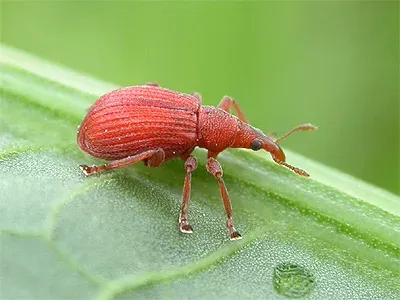
The sorrel seed weevil (Apion frumentarium) is a small beetle belonging to the family Apionidae within the order Coleoptera, measuring about 2.5 to 3.5 mm in length.
Its body has a distinctive pear-like shape typical of the Apioninae subfamily and is characterized by a bright red or reddish-brown coloration.
The snout, or rostrum, of this beetle is thin and slightly curved, allowing it to penetrate plant tissues for feeding and oviposition purposes.
Larvae are legless and whitish, possessing a dark head capsule, and complete their development entirely inside the generative organs of the host plant.
Adults overwinter in the soil or under plant debris, emerging in early spring as soon as temperatures become favorable for their activity.
What it damages
The primary hosts for this pest are plants from the genus Rumex (sorrel), including cultivated varieties grown for food consumption.
Both adults and larvae cause damage: adults feed on leaves, creating small holes, while larvae feed internally on the developing seeds and flower structures.
When infestation levels are high, the aesthetic quality of the leaves is severely compromised due to the extensive feeding damage caused by the adult weevils.
The most significant economic damage occurs in seed production fields, as larvae consume the internal contents of the seeds, rendering them unviable.
Affected inflorescences often show signs of premature wilting, deformity, and a substantial reduction in total harvest yield for seed collectors.
When it appears
Adults emerge from hibernation during the early vegetative phase, typically between April and May, depending on regional climatic conditions.
Flowering is the most critical period for the plant, as female weevils actively deposit eggs into the developing flower buds and seed pods.
The entire life cycle of one generation typically lasts between 30 and 45 days, heavily influenced by the prevailing temperature and moisture levels.
The period of maximum pest pressure coincides with the formation and maturation phase of the sorrel seeds, leading to high potential losses.
By late summer, the new generation of adults reaches maturity and subsequently migrates to protected overwintering sites for the cold season.
Signs of infestation
Visual identification of the pest includes spotting numerous small holes on the sorrel leaves, often mistaken for damage caused by flea beetles.
A primary indicator of infestation is the yellowing and premature death of flower clusters, which fail to develop properly due to larval feeding.
During the day, adult weevils can be easily spotted; they exhibit a "drop and feign death" behavior when disturbed or touched.
Dissecting infested flower buds or seed pods will reveal the larvae or their frass, confirming the presence of the seed weevil within the tissues.
General plant stress, stunted growth of the seed stalks, and decreased germination rates of harvested seeds indicate a serious pest problem.
Control measures
A crucial preventive measure is the systematic removal of wild Rumex species and related weeds that act as reservoir hosts for the pest population.
Thorough soil cultivation in the autumn can destroy overwintering sites, significantly reducing the population density for the following season.
In cases where seed production is not the goal, timely removal and destruction of flower stalks before the larvae mature can break the life cycle.
Chemical control with registered insecticides may be necessary during peak activity, provided that pre-harvest intervals are strictly observed.
- Implement proper crop rotation cycles.
- Maintain strict weed control in and around the fields.
- Destroy infested plant residues post-harvest.
- Monitor pest population using physical traps.
Taxonomy
- Latin name
- Apion frumentarium
- Order
- Coleoptera (beetles)
- Family
- Apionidae
- EPPO code
- APIOFR
Discussion
No discussions yet — be the first.