
Mallow seed weevil
Apion filirostre
Description
How to identify
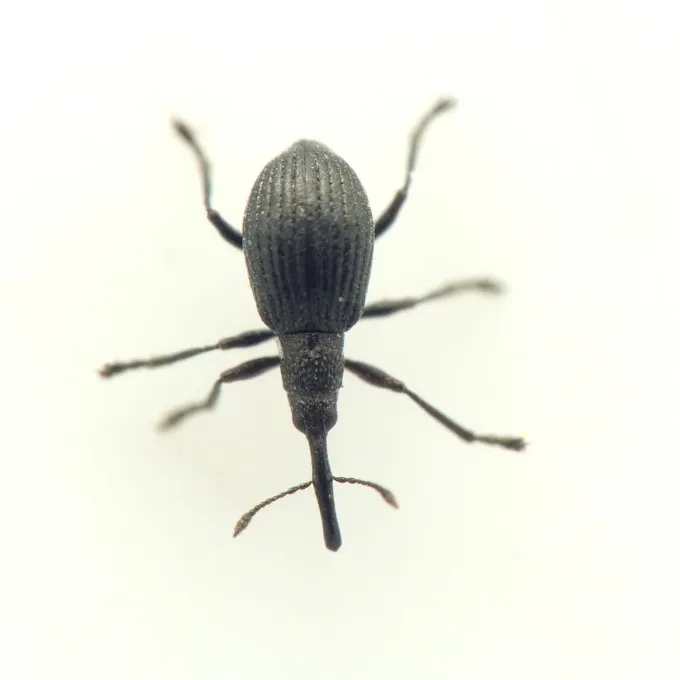
The mallow seed weevil, scientifically known as Apion filirostre, is a small beetle belonging to the Apionidae family. Adult weevils are typically 2–3 mm long, featuring a distinct pear-shaped body and a slender, elongated snout.
Their coloration is generally dark grey to black, often with a slight metallic sheen. They possess fully functional wings, allowing them to fly between plants to search for suitable hosts within the Malvaceae family.
The larvae are legless, C-shaped, and creamy white or yellowish. They spend their entire developmental period hidden inside the seed pods of host plants, which makes them invisible during routine inspections.
These insects are highly specialized, thriving primarily on plants like Alcea (hollyhock), Malva (mallow), and Hibiscus. Their lifecycle is closely synchronized with the flowering and seed-setting phases of these plants.
Adults overwinter in the soil or under organic debris, emerging in the spring when temperatures consistently reach levels suitable for plant growth and mating.
What it damages
The damage caused by Apion filirostre is focused on the reproductive organs of the plants. Adults feed on buds and flowers, leaving small holes that can cause malformation and aesthetic damage to blooms.
However, the most severe damage is caused by the larvae, which bore into the developing seed pods. They consume the maturing seeds, often destroying the entire contents of the pod before the plant can set viable seed.
This feeding behavior leads to a significant loss of seed yield. For seed-production nurseries, this pest can cause economic devastation by reducing germination rates and overall crop quality.
The punctures made by females during egg-laying also serve as entry points for various bacterial and fungal pathogens, potentially leading to rot and the premature collapse of the fruit.
Premature shedding of buds and stunted growth of seed pods are common outcomes of heavy infestation, often resulting in sparse flowering and failed reproduction for the host plants.
When it appears
Activity typically begins in late spring, around May, as temperatures rise. The weevils migrate from their overwintering sites to young host plants to begin feeding.
Mating occurs shortly after emergence, followed by the female boring a hole into the young ovary to deposit a single egg. This process is repeated across multiple seed pods.
The larval stage lasts for several weeks. During this time, the larvae undergo multiple molts and pupation entirely within the shelter of the pod, protected from external predators.
The emergence of the next generation of adults usually coincides with the maturation of the seeds in mid-to-late summer, allowing for a potential second generation or migration to find better overwintering sites.
As autumn approaches, the adults seek protected areas in the upper layers of soil or leaf litter to survive the winter, remaining inactive until the following spring.
Signs of infestation
The most noticeable sign of infestation is the presence of tiny, pin-prick-sized holes on the petals or unopened buds of mallow plants. These holes are clear indicators of adult feeding activity.
If you observe that pods are turning yellow or brown earlier than expected, or if they appear smaller and misshapen, it is highly likely that larvae are feeding inside.
Upon opening a suspected pod, you will find dark frass (insect excrement) and damaged seeds that appear hollowed out or shredded, confirming the presence of the pest.
Sudden shedding of immature buds is another diagnostic sign. If these buds are dissected, one can often find small larvae or evidence of internal tunneling.
Early morning monitoring can reveal adult weevils resting on the stems or buds, as they are less active during the cooler parts of the day and easier to spot against the foliage.
Control measures
Cultural control methods are the first line of defense. Deep autumn cultivation of the soil can disrupt overwintering sites and expose the beetles to predators and harsh environmental conditions.
Sanitation is critical: promptly gathering and destroying infested seed pods and cleaning up fallen plant debris prevents the next generation from successfully emerging and overwintering.
Chemical control, if necessary, should be applied with systemic insecticides during the early bud formation stage, prior to full bloom, to avoid killing beneficial pollinators.
- Apply insecticides during the late evening to minimize impact on bees.
- Use physical barriers or nets on high-value plants to prevent beetle access.
- Rotate crops or remove wild Mallow species near production areas to break the cycle.
Biological control, including the use of entomopathogenic nematodes or fungi, can provide some relief, though its efficacy depends on specific environmental conditions like humidity and soil moisture.
Taxonomy
- Latin name
- Apion filirostre
- Order
- Coleoptera (beetles)
- Family
- Apionidae
- EPPO code
- APIOFI
Discussion
No discussions yet — be the first.