
Thistle seed weevil
Apion carduorum
Description
How to identify
The Thistle seed weevil (Apion carduorum) belongs to the Apionidae family, which is part of the Coleoptera order.
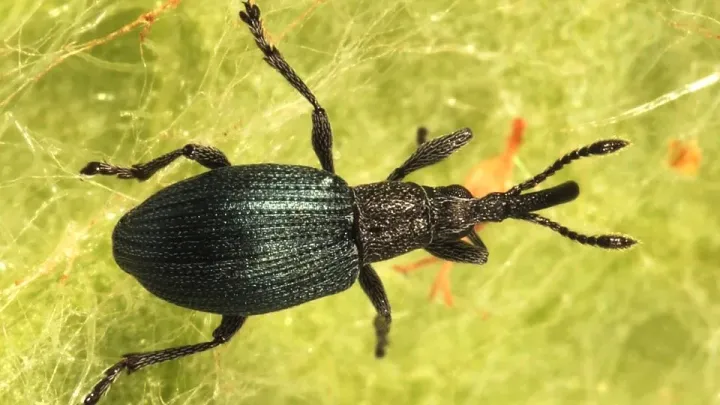
Adult weevils are small, typically measuring between 2.5 to 3.5 millimeters, with a distinctive pear-shaped body and a long, slender rostrum.
Their coloration is generally dark or black, often with a subtle metallic sheen, which provides camouflage while resting on host plants.
The larvae are legless, white-to-cream colored, with a robust head capsule, and they remain hidden throughout their developmental stage inside the plant head.
This species is highly adapted to the Asteraceae family and is commonly found in temperate regions across Europe and other parts of the world.
What it damages
The primary hosts for this weevil are plants within the Carduus genus, commonly known as thistles, which are often treated as agricultural weeds.
Adults consume soft plant tissues such as leaves and stems, causing minor feeding damage, but the significant impact is caused by the larval stage.
Larvae develop inside the flower heads, feeding directly on the developing seeds and preventing the plant from producing viable offspring.
This larval feeding causes the flower heads to become deformed, leading to poor seed set and effectively reducing the weed's ability to propagate.
By damaging the reproductive organs of thistles, this insect acts as a natural pressure agent on weed populations within field margins and pastures.
When it appears
Adult weevils overwinter in sheltered areas, such as leaf litter, debris, or the top layer of soil, where they survive dormant during the winter months.
Activity resumes in early spring as temperatures rise, matching the emergence and growth phase of thistle plants.
Mating and oviposition occur during the flowering period, as female weevils search for suitable thistle heads to deposit their eggs.
The larval cycle is synchronized with the development of the host plant's seeds, ensuring that larvae have enough food to reach maturity.
By late summer or early autumn, the new generation of adults emerges, feeds briefly, and then seeks overwintering sites for the cold season.
Signs of infestation
Feeding marks by adults appear as small, circular, or irregular holes on the leaves of young thistle plants during the vegetative stage.
Deformed or asymmetrical flower heads often indicate internal infestation, where larvae have disrupted the normal growth of the receptacle.
Dissecting a thistle head during the season may reveal larvae, pupae, or remnants of consumed seeds mixed with frass.
Reduced seed production is a major sign of infestation, which can be observed by comparing infested heads to healthy ones in the late season.
- Adults found on the surface of thistle flower heads.
- Premature browning or drying of flower heads before maturity.
- Visible larval galleries within the heart of the flower receptacle.
Control measures
Effective management is largely focused on cultural practices, such as mowing thistles before they reach the seed-set stage to disrupt the lifecycle.
Destroying the host plants in field margins and wastelands helps to reduce the local population of the weevil significantly.
Deep plowing in late autumn can bury overwintering adults, reducing the likelihood of a high population density in the following growing season.
Chemical control is rarely necessary for this species, as it is generally considered a non-pest of cultivated crops and often a beneficial weed suppressor.
Integrated weed management remains the most sustainable approach to controlling the thistle seed weevil by keeping thistle populations at a manageable level.
Taxonomy
- Latin name
- Apion carduorum
- Order
- Coleoptera (beetles)
- Family
- Apionidae
- EPPO code
- APIOCA
Discussion
No discussions yet — be the first.