
Coffee bean weevil
Araecerus levipennis
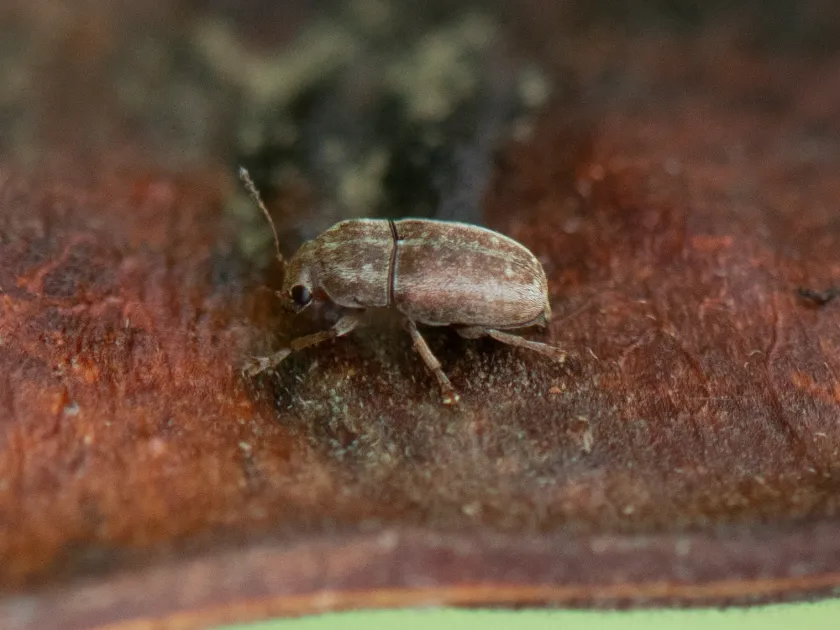
Description
How to identify
The Coffee bean weevil (Araecerus levipennis) is a member of the Anthribidae family within the order Coleoptera. This beetle is a serious pest of stored products, measuring approximately 3 to 5 mm in length, with a robust oval-shaped body and prominent club-shaped antennae.
The adult beetle typically exhibits a mottled coloration ranging from dark brown to black, often with patches of lighter hairs. This camouflage allows the insect to blend seamlessly into the texture of coffee beans or seeds, making them difficult to spot during routine inspections of stored batches.
The larva of the Coffee bean weevil is legless, white to cream-colored, with a hardened brown head capsule. It spends its entire developmental stage boring tunnels inside the host product, where it grows and eventually builds a chamber for pupation.
The life cycle of the weevil is highly dependent on environmental conditions, particularly temperature and humidity. In well-regulated warehouse conditions, the insect can breed continuously throughout the year, leading to overlapping generations and a rapid increase in population density.
Adult beetles are capable of flight, which facilitates their movement across warehouses and the infestation of new product batches. This mobility makes it essential to implement strict phytosanitary measures in facilities handling susceptible goods like coffee, cacao, and various seeds.
What it damages
The primary hosts for this pest are coffee beans, although it is a polyphagous insect that attacks a wide range of products. Beyond coffee, it infests cacao beans, maize, various pulses, peanuts, and even dried fruits, causing significant economic losses in the food industry.
Larvae feed internally on the kernels, creating intricate tunnels and consuming the nutrient-rich core. As a result, the infested product is reduced to a hollowed-out shell filled with frass and excrement, making the entire batch unfit for consumption or market sale.
Infested stocks suffer from significant weight loss, loss of quality, and deterioration of aroma and flavor profiles. In tropical regions, this pest is notorious for attacking crops in the field before the harvest, leading to pre-existing infestations that complicate long-term storage safety.
The presence of high numbers of beetles can lead to heat spots within stored piles, which in turn promotes mold growth and secondary contamination. This makes the management of the Coffee bean weevil a critical component of post-harvest quality assurance and logistics.
- Coffee beans
- Cacao beans
- Pulses and legumes
- Peanuts
- Dried fruits
Signs of infestation
The most evident sign of infestation is the presence of small, round exit holes on the surface of individual beans. These holes are created by emerging adults or larvae exiting the food source after completing their development cycles.
Another clear indicator is the accumulation of fine, dust-like powder or particles beneath storage sacks. This material is a combination of product debris and insect waste pushed out from the internal tunnels, signaling active destruction of the kernel's structure.
A musty or decaying odor in the storage area often points to an infestation of this weevil. This smell is produced by the breakdown of organic material and the development of fungi in environments affected by the insect's life processes.
Seeing adult beetles crawling on the surface of bags or flying near lights is a major alert. The insects are often more active at twilight, so using light traps or pheromone monitors during these periods can reveal the scale of the infestation early on.
A sudden, unexplained decrease in the weight of stored batches is a red flag. Regular monitoring of stock weight and moisture levels can provide early evidence of pest activity before visual symptoms become widespread throughout the warehouse.
Control measures
Fumigation remains the most effective method for controlling the Coffee bean weevil in warehouses. Using approved phosphine-based fumigants ensures penetration into the bulk product, effectively killing eggs, larvae, and adults hidden deep within the beans.
Preventative measures are essential, starting with strict control of temperature and humidity. Maintaining storage moisture content below 13% is generally sufficient to slow down or inhibit the development of the weevil, helping to protect product integrity during long-term storage.
Warehouse sanitation is a mandatory practice before introducing new stock. Removing all dust, residual grain, and debris prevents the pest from finding safe harbor, effectively breaking the cycle of re-infestation between different batches of products.
Implementing specialized packaging, such as high-barrier or vacuum-sealed bags, can physically prevent weevils from reaching the product. Vacuum packaging is particularly effective, as it removes oxygen, creating an environment where the insects cannot survive and thrive.
Continuous monitoring using pheromone-baited traps allows warehouse managers to detect the presence of the beetle early. Early detection enables targeted spot treatments, which are far more cost-effective and environmentally friendly than complete batch fumigation.
Taxonomy
- Latin name
- Araecerus levipennis
- Order
- Coleoptera (beetles)
- Family
- Anthribidae
- EPPO code
- ARAELE
Discussion
No discussions yet — be the first.