
Fungus weevil
Anthribus
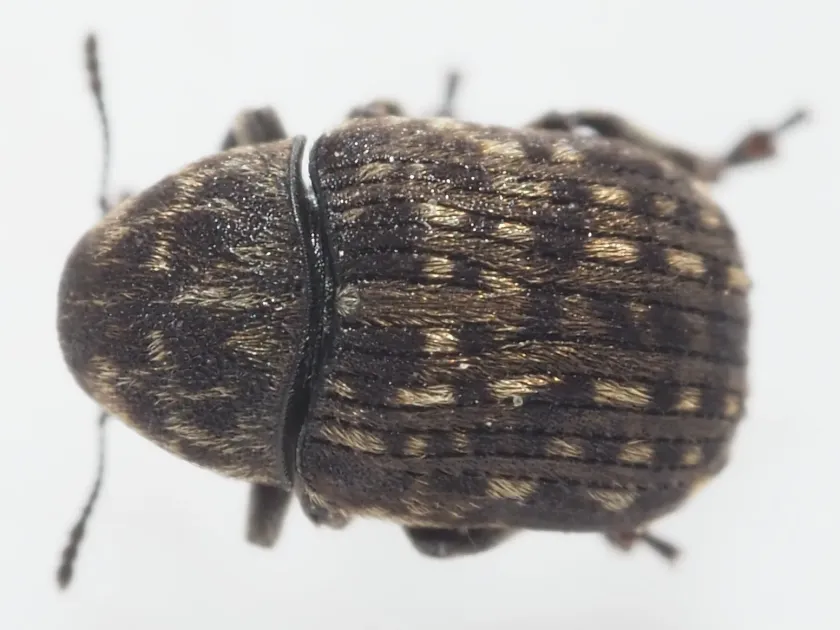
Description
How to identify
Fungus weevils belong to the family Anthribidae, order Coleoptera. While they share a superficial resemblance to true weevils, they are easily distinguished by their non-elbowed antennae and different snout morphology.
The body is typically robust, covered in dense scales or hairs, which provide effective camouflage on tree bark, fungi, or plant matter, helping them evade predators.
They possess a broad, short snout compared to the elongated rostra of Curculionidae, which is the most reliable taxonomic trait for differentiating this family in the field.
Larvae are C-shaped, legless, and possess a well-developed head capsule with powerful mandibles designed for boring into wood, fungi, or seeds.
Taxonomically, this family is quite diverse, with many species specialized for specific ecological niches, including decaying wood and fungal substrates.
What it damages
The damage caused by these insects is primarily seen in forestry and stored agricultural products, where they can compromise the integrity of seeds and wood.
Larvae feed internally, creating tunnels within fruits, seeds, or under the bark, which weakens the plant tissue and creates entry points for secondary pathogens.
In orchards, while often associated with dead or dying wood, some species can attack living tissue, especially if the tree is already under stress from disease or drought.
Seed-infesting species are particularly problematic in grain storage and nursery settings, as they destroy the embryo, rendering the seeds non-viable.
The presence of their excrement and the physical destruction of tissues lead to rapid deterioration of infested stocks, posing a significant risk in controlled storage environments.
When it appears
The active life cycle usually begins in the spring, triggered by rising temperatures, when overwintering adults emerge to feed and locate suitable sites for egg-laying.
The peak mating season occurs during early summer, ensuring that larvae emerge in synchrony with the optimal developmental phase of their host plants or fungal sources.
Development from egg to adult often spans several months, with larvae remaining sheltered inside their food source, protected from external climate fluctuations.
Overwintering typically occurs as adults or mature larvae, tucked away in bark crevices, beneath forest litter, or deep within dried, infested plant remains.
Environmental factors, such as humidity, play a crucial role in the survival rate of the larvae, favoring moist conditions common in their natural forest habitats.
Signs of infestation
One of the clearest indicators of an infestation is the appearance of small, round exit holes on the surface of bark, fruit, or seeds, indicating that adults have emerged.
The accumulation of frass or sawdust around holes or on leaves beneath a tree serves as a major sign of internal feeding activity by the larval stages.
In trees, localized wilting or necrotic patches on the bark often signify that larval boring has disrupted the vascular flow or caused structural damage.
When stored grains are inspected, the presence of empty seed husks filled with debris or white, fleshy larvae is a definitive symptom of infestation.
A sudden increase in adult beetle sightings near infested products is a warning sign that the population is expanding and requires immediate containment.
Control measures
The primary control strategy involves good sanitation: removing dead wood, fallen branches, and decaying organic matter where these insects thrive.
For stored goods, maintaining low moisture content in the storage facility and using airtight containers is essential to prevent successful egg-laying and larval survival.
Chemical control is rarely necessary but can be implemented through localized insecticide applications during the adult emergence phase in late spring.
- Pruning and destroying infected branches to lower the localized pest population.
- Using pheromone traps or sticky barriers to monitor the presence of adult beetles.
- Implementing biological controls, such as beneficial parasitic wasps, in larger nursery operations.
Integrated Pest Management (IPM) practices, emphasizing early detection and habitat modification, are the most sustainable ways to keep these weevils from becoming a serious issue.
Taxonomy
- Latin name
- Anthribus
- Order
- Coleoptera (beetles)
- Family
- Anthribidae
- EPPO code
- ANTBSP
Discussion
No discussions yet — be the first.