

Cigarette beetle
Lasioderma serricorne
Description
How to identify
The Cigarette beetle (Lasioderma serricorne) belongs to the order Coleoptera and the family Ptinidae (formerly Anobiidae). These insects are small, typically measuring between 2 and 3 millimeters in length.
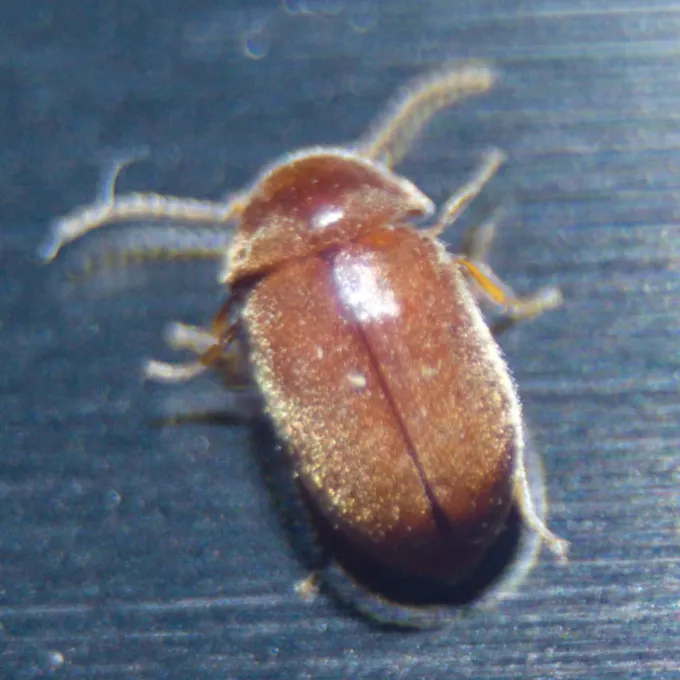
Adults are oval-shaped and possess a reddish-brown color, covered with fine, soft hairs. The head is sharply bent downwards and retracted into the prothorax, giving the beetle a distinctively humped appearance.
Larvae are creamy-white, C-shaped, and covered in dense hairs. They are the stage responsible for the majority of the damage as they bore through various materials using their strong mouthparts.
The life cycle undergoes complete metamorphosis: egg, larva, pupa, and adult. The speed of the cycle depends heavily on the ambient temperature and moisture levels of the storage environment.
Under optimal conditions—temperatures around 30 degrees Celsius—the entire life cycle can be completed in as little as 25 to 30 days, leading to rapid population outbreaks.
What it damages
As the name suggests, the primary food source is dried tobacco products, including cigarettes, cigars, and baled tobacco. They can tunnel through even the most tightly packed materials.
Cigarette beetles are generalist feeders and infest a wide variety of dried plant-based products, such as cereals, flour, spices, dried fruits, cocoa, and various herbs used in medicine.
This pest is a significant concern for museums and libraries, where it feeds on herbarium specimens, insect collections, taxidermy, and even book bindings that use flour or starch-based glues.
The damage caused is not limited to consumption. The presence of larvae and their frass (excrement) contaminates the product, rendering it unusable and aesthetically unappealing for commercial sale.
The presence of adults emerging from the substrate leaves characteristic exit holes, which serve as a primary indicator that a significant infestation has already established itself within the material.
When it appears
In climate-controlled warehouses, food processing facilities, or homes, the Cigarette beetle can breed continuously throughout the year, meaning there is no distinct seasonal limit to its activity.
In unheated environments, activity slows down significantly as temperatures drop. However, the beetles remain dormant as larvae within the food source until temperatures rise again during the spring.
Because generations develop so quickly during the warmer months, populations can grow exponentially in a very short period if sanitation measures are neglected in storage areas.
Adult beetles are strong fliers and are particularly active during the twilight hours or at night. They can easily fly from infested areas to infest new, clean batches of stored goods nearby.
They are capable of overwintering in various stages within infested substrate, allowing them to survive winter months provided the material itself does not freeze completely for an extended period.
Signs of infestation
The most visible sign of an infestation is the presence of tiny, circular exit holes, approximately 1 millimeter in diameter, on the surface of packages or the tobacco products themselves.
Sifting through stored goods often reveals fine, dust-like powder (frass) which is a mixture of plant particles and larval excrement, indicating that the product has been processed by the insects.
Adult beetles are frequently spotted crawling on surfaces, such as walls, windowsills, or near the storage containers, which indicates an active population is present in the vicinity.
Infested materials may emit a stale or musty odor, resulting from the accumulation of frass and the secondary growth of molds triggered by the insect activity within the enclosed space.
- Presence of tiny circular holes in packaging.
- Accumulation of fine powder under storage containers.
- Live beetles seen near tobacco or food supplies.
- Damaged containers or shredded packaging materials.
Control measures
Strict sanitation and inspection are the first lines of defense. Inspect all incoming goods thoroughly and rotate stock to prevent long-term storage of susceptible items in one place.
Removing loose particles and spilled material is crucial. Cleanliness in storage areas prevents the establishment of a breeding reservoir that could sustain the population over time.
For severe infestations in industrial settings, professional fumigation is the most effective solution. This must be carried out by certified experts using appropriate regulatory-approved chemicals.
Freezing is an effective method for small-scale household control. Placing infested items in a freezer at -15 degrees Celsius for at least 72 hours will kill eggs, larvae, and adults.
Storing items in airtight containers made of glass, metal, or rigid plastic effectively prevents re-infestation. Monitoring with pheromone traps can help detect the presence of beetles early.
Content graph
Connections · Cigarette beetle
Most often together:
Marketplace
Products · 1
Biology
Taxonomy
- Latin name
- Lasioderma serricorne
- Order
- Coleoptera (beetles)
- Family
- Anobiidae
- EPPO code
- LASDSE
Community
Discussion
No discussions yet — be the first.