
Saffron thrips
Thrips safrus
Description
How to identify
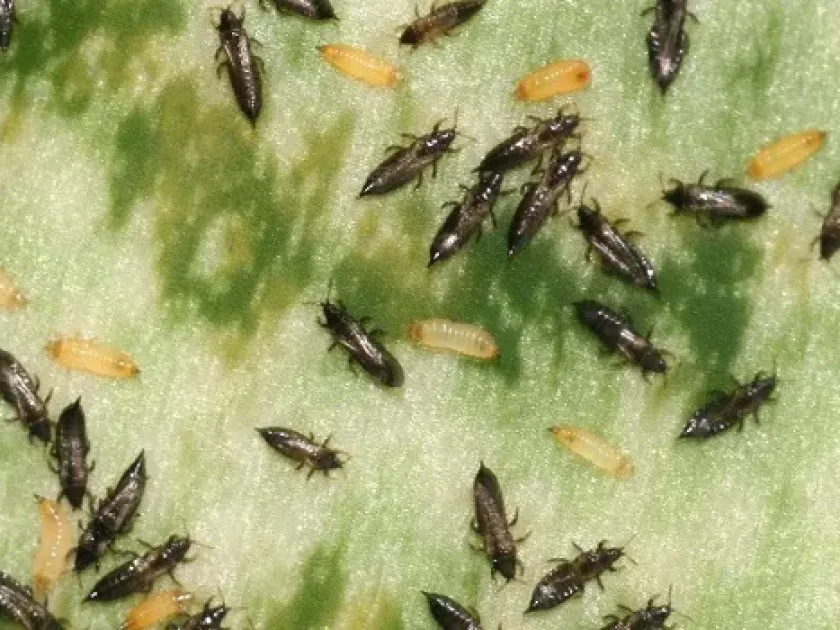
Saffron thrips (Thrips safrus) is a tiny insect belonging to the order Thysanoptera and the family Thripidae. The adult form measures approximately 1–1.5 mm in length and possesses slender bodies with two pairs of feathery wings.
Their coloration typically ranges from light yellow to brownish, providing excellent camouflage against plant tissues. Larvae appear similar to adults but are wingless and have a translucent or pale appearance.
These pests are cryptic, residing in concealed areas such as leaf axils, unopened flower buds, and beneath the scales of bulbs. Their high mobility allows them to spread rapidly across fields and storage facilities.
The life cycle encompasses stages of egg, two larval instars, prepupa, pupa, and adult. Pupation often occurs in the soil or within dried plant debris, which significantly complicates the detection and eradication of the population.
The rate of development is highly dependent on temperature. In conditions above +20°C, the cycle can complete in as little as two weeks, leading to massive population outbreaks during the peak growing season.
What it damages
While their primary host is the saffron crocus (Crocus sativus), they also affect various other bulbous species, including tulips and gladioli. This polyphagous nature makes them a consistent threat to bulb crops.
Damage occurs when both adults and larvae puncture plant cells to extract sap. This feeding process destroys the cellular structure and interferes with the plant’s normal physiological functions, including photosynthesis.
Infested bulbs often lose turgor, become susceptible to desiccation, and are prone to secondary rot infections. Significant infestations can drastically reduce bulb vitality and future planting viability.
Furthermore, these insects act as vectors for various plant viruses. By piercing tissues, they facilitate the transmission of pathogens that cause mosaic patterns, petal color breaking, and general plant distortion.
The economic impact is primarily driven by the loss of aesthetic value in flowers and the reduced harvest of high-quality spice or planting stock. Marked and deformed flowers are frequently rejected by market standards.
Signs of infestation
The initial signs of infestation are silver or white streaks appearing on the foliage. These marks are caused by the empty, collapsed plant cells left behind after the insects have fed.
Flower buds attacked by thrips often fail to open properly or show severe malformations. Petals frequently exhibit brownish spots or necrotic patches, which significantly diminish the plant's beauty.
Black or dark brown dots, which are the excrement of the thrips, are a reliable indicator of their presence. These spots are usually concentrated in the most sheltered parts of the plant, such as the base of leaves.
In dry conditions, infested plants may show rapid yellowing and premature leaf senescence. The overall growth is stunted, and the plant appears to be suffering from water or nutrient stress.
Bulbs inspected during or after harvest often show soft, sunken patches where the epidermis has been damaged. Such bulbs serve as a reservoir for the pest, ensuring infestation in the following season.
Control measures
Effective management requires an integrated pest management (IPM) approach. The most critical step is to ensure that only clean, certified, and healthy planting material is introduced to the farm.
Pre-planting treatments, such as hot water dips or systemic insecticidal soaks, can help eliminate dormant stages of the pest hidden under bulb scales, preventing early-season outbreaks.
During the growing season, systemic insecticides should be applied when the population reaches a predetermined threshold. It is essential to rotate between different chemical classes to prevent the build-up of resistance.
Blue sticky traps are highly recommended for monitoring purposes. These traps allow growers to detect the arrival of the pest early and decide on the precise timing for intervention measures.
Cultural practices, including the removal and destruction of crop debris and deep autumn plowing, are highly effective in reducing the overwintering population, thereby lowering the pressure for the next season.
Taxonomy
- Latin name
- Thrips safrus
- Order
- Thrips
- Family
- Thripidae
- EPPO code
- THRISF
Discussion
No discussions yet — be the first.