
Minute thrips
Thrips minutissimus
Description
How to identify
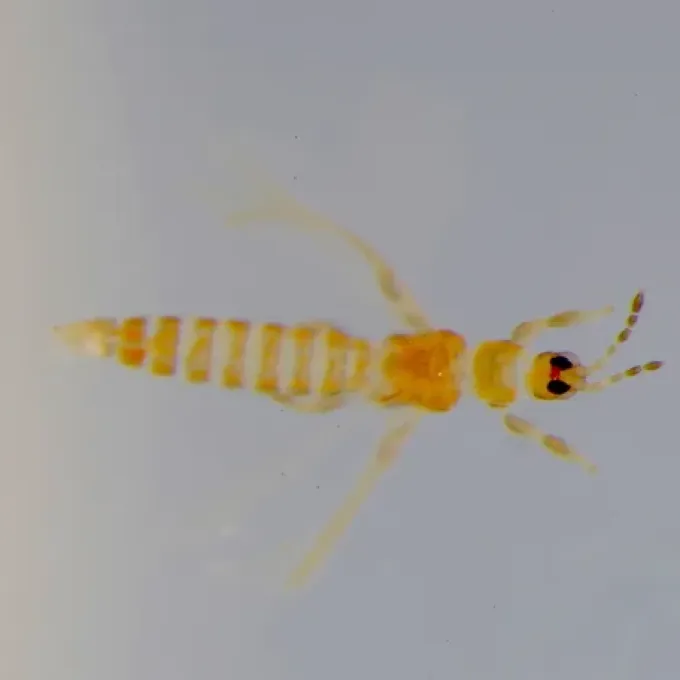
The minute thrips (Thrips minutissimus) is a member of the order Thysanoptera and the family Thripidae. As the name suggests, this is a tiny insect, typically measuring about 1 mm in length, making it difficult to detect with the naked eye.
Adults possess an elongated body ranging from pale yellow to brownish in color. They are equipped with narrow wings fringed with fine hairs, which are highly efficient for wind-assisted dispersal across fields and greenhouses.
The life cycle encompasses several stages: egg, two larval instars, prepupa, pupa, and adult. This species is known for its rapid reproductive rate, allowing it to complete multiple generations within a single growing season under warm conditions.
They typically overwinter as adults, finding shelter in the soil, leaf litter, or under tree bark. Once temperatures rise, they emerge to infest young foliage, buds, and flowers, starting the cycle anew.
Identification of this species is complex due to its similarity to other thrips species. Precise classification often requires microscopic examination of the antenna structure and the specific arrangement of setae on the body.
What it damages
This species is a generalist feeder that attacks a wide variety of plants, including fruit trees, berry bushes, vegetable crops, and various ornamental species. It causes significant economic losses in both open field agriculture and protected greenhouse environments.
Signs of infestation
Early symptoms of infestation include the appearance of tiny silvery streaks or stippling on the leaves. As the insect feeds on plant cells, these markings coalesce into larger necrotic patches, leading to leaf distortion and curling.
Floral damage is also common, characterized by distorted petals, stunted flower development, and the eventual abscission of buds. The overall vigor of the host plant decreases significantly, affecting both aesthetic and yield quality.
Control measures
Effective management requires an integrated pest management (IPM) approach. Cultural practices, such as soil cultivation and the removal of host weeds, are critical for disrupting the lifecycle and reducing overwintering populations.
Monitoring is essential; the use of colored sticky traps can help detect the arrival of the pest early, allowing for timely intervention before populations reach economic damage thresholds.
- Application of systemic insecticides like spinosad or neonicotinoids.
- Use of biological control agents such as predatory mites (e.g., Amblyseius spp.).
- Maintaining adequate humidity levels, as high moisture can suppress thrips activity.
- Implementing strict sanitation protocols in greenhouses to eliminate breeding sites.
- Rotating crops to prevent continuous infestation cycles in the same area.
Taxonomy
- Latin name
- Thrips minutissimus
- Order
- Thrips
- Family
- Thripidae
- EPPO code
- THRIMI
Discussion
No discussions yet — be the first.