
Rose thrips
Thrips fuscipennis
Description
How to identify
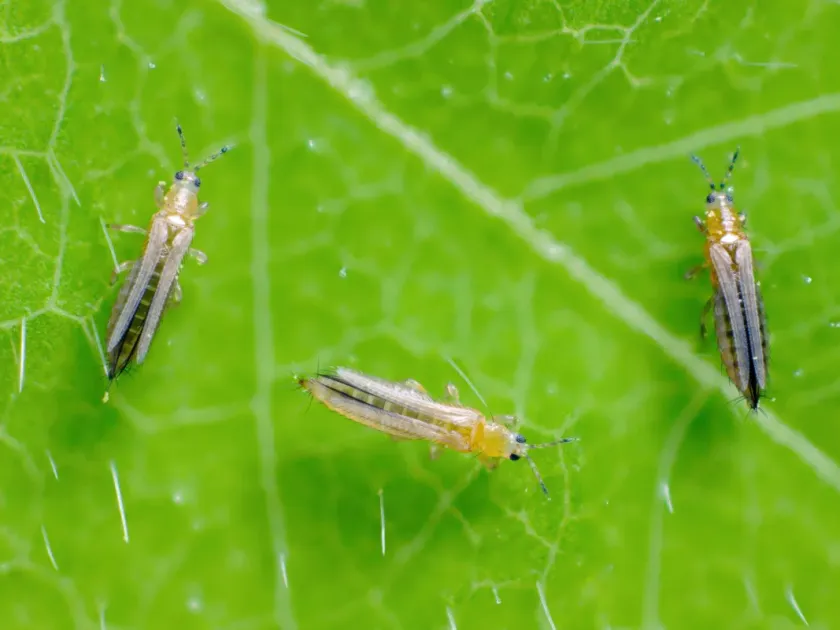
The rose thrips (Thrips fuscipennis) belongs to the order Thysanoptera, family Thripidae. These are tiny insects measuring 1–1.5 mm, typically brownish or yellowish in color with elongated bodies.
Adults possess two pairs of narrow wings fringed with hairs, which are highly efficient for dispersal and migration between host plants during warm weather conditions.
The larvae resemble the adults but are smaller, wingless, and usually lighter in color. They are highly active and can quickly colonize various parts of the plant.
Their life cycle includes egg, two larval stages, prepupa, pupa, and adult. Pupation often occurs in the soil or protected niches of the plant, which makes this stage resilient against many contact pesticides.
The species is particularly active in greenhouses and during warm summer months, with the ability to complete multiple generations within a single season.
What it damages
The primary hosts are plants of the Rosaceae family, especially garden roses, though they also infest strawberries, grapes, and various ornamental flowering shrubs.
Feeding occurs by piercing plant cells and sucking out the sap. This leads to the destruction of cellular content, which manifests as stippling, silvering, and necrotic spots on leaves and petals.
Heavy infestations lead to significant deformation of buds and flowers, often preventing the bloom from opening properly, which severely affects the ornamental value of roses.
In addition to direct physical damage, rose thrips are known to be vectors for certain plant viruses, which can cause systemic infections and weaken the entire plant.
Stunted growth of new shoots and leaves is a common consequence of chronic thrips pressure, leading to reduced photosynthetic capacity and overall decline in plant health.
Signs of infestation
The earliest signs of infestation are silver or white flecks on the upper leaf surface, followed by the appearance of dark, pinpoint excrement on the undersides of leaves.
Flower buds often show brown streaks or patches on the outer petals. These symptoms are frequently misidentified as fungal infections, but the presence of larvae inside the bud confirms thrips.
Severely damaged buds may become gnarled or fail to develop completely, resulting in malformed, dry, or discolored flower petals that shatter prematurely.
The presence of sticky honeydew might occur in some cases, although less characteristic than in aphids, it often supports the growth of sooty mold on the foliage.
A simple test involves tapping a suspect flower over a piece of white paper; if thrips are present, they will fall out and be easily visible as tiny, fast-moving "splinters."
Control measures
Cultural control is essential: removing weeds, debris, and infested plant parts helps eliminate overwintering sites and reduces the pest population early in the season.
Blue sticky traps are highly recommended for monitoring the presence and population density of adults, helping to determine the precise timing for intervention.
Chemical control should rely on systemic insecticides that are absorbed by the plant tissue, ensuring effective coverage against pests hidden deep within buds or curled leaves.
Effective chemical classes include spinosyns, neonicotinoids, and avermectins, which should be used in a rotational program to mitigate the risk of resistance development.
Biological control using predatory mites (e.g., Amblyseius cucumeris) or minute pirate bugs (Orius spp.) provides excellent results in greenhouse environments and protected gardens.
Taxonomy
- Latin name
- Thrips fuscipennis
- Order
- Thrips
- Family
- Thripidae
- EPPO code
- THRIFU
Discussion
No discussions yet — be the first.