
Dracaena thrips
Parthenothrips dracaenae
Description
How to identify
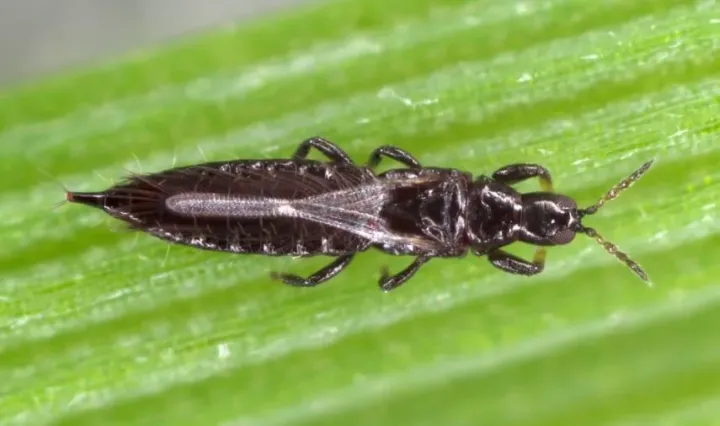
Dracaena thrips (Parthenothrips dracaenae) is a significant pest belonging to the order Thysanoptera. These insects are very small, usually measuring about 1.0 to 1.5 millimeters in length.
The adult thrips typically have a brownish-yellow to brown body color with fringed wings that are tucked along the back, forming a noticeable dark line when at rest.
The larvae are wingless, paler in color, and often reside in groups on the underside of leaves. They are highly active feeders that thrive in warm, dry environments such as greenhouses and offices.
The development stages consist of eggs, larvae, prepupae, pupae, and adults. This transition allows them to survive in various microclimates within a single plant.
Because they can reproduce parthenogenetically, the absence of males does not limit the rapid expansion of their population, which often leads to severe infestations in confined spaces.
What it damages
These insects are polyphagous pests, meaning they attack a wide range of host plants including Dracaena, Ficus, Monstera, and various ornamental palms.
They feed by piercing the plant tissue and sucking the cell sap. This feeding process destroys the chlorophyll-containing cells, leading to a loss of photosynthetic efficiency.
The damage initially appears as tiny silvery or bleached spots on the foliage. Over time, these spots expand, causing the leaves to become distorted, pale, and brittle.
Heavy feeding causes premature leaf yellowing and dropping. This significantly reduces the aesthetic and commercial value of ornamental plants grown in nurseries or homes.
Excrement left by the thrips creates dark spotting and promotes the growth of sooty mold, which blocks light and further weakens the plant's health.
Signs of infestation
The most distinctive symptom is the presence of silvery, stippled streaks on the upper leaf surface, caused by air entering the cells after the thrips have consumed the sap.
Small dark fecal spots on the underside of leaves serve as a diagnostic indicator of thrips activity. These spots are often accompanied by the presence of larvae.
The curling of young leaves and a general lack of vigor in new growth indicate a long-term infestation that is starving the plant of nutrients.
The appearance of sticky, shiny surfaces on the leaves is often an indication of either insect excretions or the subsequent development of fungal growth.
Visual observation with a magnifying glass reveals adult thrips scurrying across the leaf blade, a behavior that is triggered when the plant is gently shaken.
Control measures
Preventative measures are highly effective. This includes keeping the ambient humidity high, as Parthenothrips dracaenae prefers dry conditions and struggles to proliferate in humid environments.
Regular inspection of the undersides of leaves is essential for early detection. Newly acquired plants should always undergo a quarantine period before being placed near others.
Mechanical control involves washing leaves with a mild soap solution, which can significantly reduce the number of insects if performed consistently at regular intervals.
Chemical control usually requires systemic insecticides. Since the eggs are laid inside the leaf tissue and pupae may be in the soil, multiple applications are necessary to kill all emerging generations.
- Quarantine all new indoor plants for at least two weeks.
- Increase humidity using misters or pebble trays.
- Use yellow or blue sticky traps for population monitoring.
- Apply systemic insecticides targeting the pests at every life stage.
Taxonomy
- Latin name
- Parthenothrips dracaenae
- Order
- Thrips
- Family
- Thripidae
- EPPO code
- PAREDR
Discussion
No discussions yet — be the first.