
Greenhouse thrips
Heliothrips haemorrhoidalis
Description
How to identify
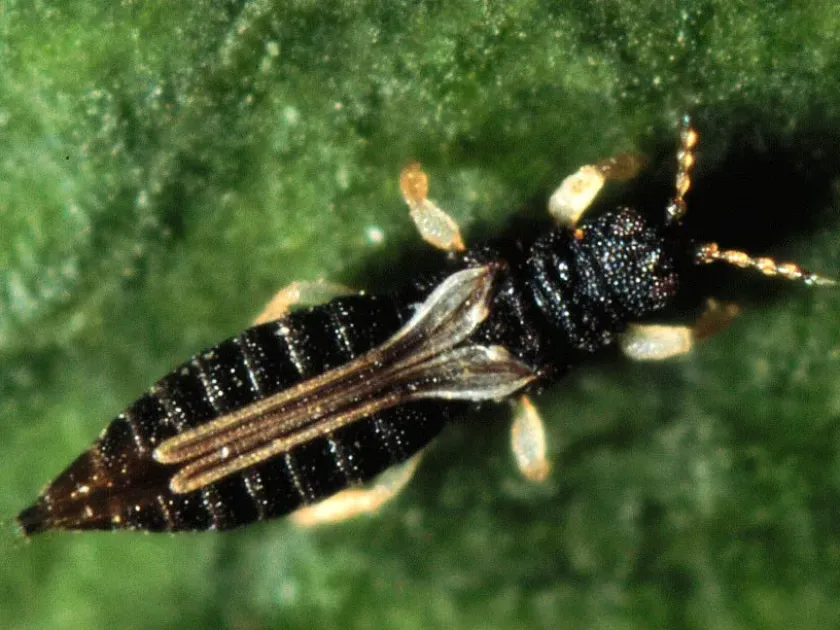
The greenhouse thrips (Heliothrips haemorrhoidalis) is a significant pest belonging to the order Thysanoptera and the family Thripidae. Adult thrips are small, roughly 1–1.5 mm long, with a dark brown or blackish body and a yellow-tipped abdomen.
The insects are equipped with narrow, fringed wings that enable them to move between host plants. Their larvae are much lighter in color, typically pale yellow or white, and are frequently found in colonies on the undersides of leaves.
Their life cycle includes egg, two larval stages, prepupa, pupa, and adult. In greenhouse environments with stable temperatures, development is continuous, allowing for multiple overlapping generations per year, which makes management challenging.
Female thrips lay their eggs individually into the leaf tissue, making tiny slits in the epidermis. This behavior protects the eggs from environmental stressors and many contact insecticides, complicating initial detection and control.
These pests thrive in warm, humid greenhouse conditions but can also tolerate drier environments. Their rapid life cycle and high fecundity mean that small initial infestations can quickly escalate into major outbreaks if not monitored.
What it damages
Greenhouse thrips are polyphagous, attacking a wide range of ornamental and edible plants, including azaleas, ferns, citrus, orchids, and many greenhouse crops. They feed by piercing plant cells and sucking out the contents.
Feeding damage results in a characteristic silvering or bronzing effect on the leaves, which is caused by air filling the empty cells. This damage significantly impairs the plant's photosynthetic capacity and overall health.
In addition to leaf damage, the insects cause discoloration and scarring on fruits and flowers, drastically reducing the marketability of ornamental products. Heavy infestations lead to leaf yellowing, desiccation, and premature drop.
Furthermore, these thrips are vectors for various plant viruses, which can lead to systemic infections. This adds another layer of economic loss, as viral diseases often necessitate the total removal and destruction of affected crops.
The waste products of the thrips—small, black, liquid excrement spots—further degrade the appearance of the plants and can provide a substrate for secondary fungal infections like sooty mold.
Signs of infestation
The most prominent sign of an infestation is the appearance of mottled, silvery-white patches on the upper surface of leaves. As feeding continues, these spots coalesce, giving the foliage a dull, chlorotic appearance.
Careful inspection of the leaf undersides usually reveals small, black, shiny droplets of excrement. These deposits are a classic diagnostic feature of a greenhouse thrips population and are easy to spot once you know where to look.
Distorted or curled leaves, especially in younger growth, often indicate a heavy infestation. In flowering plants, the damage may extend to the petals, causing browning, deformed blooms, or premature bud drop.
Using blue sticky traps is a standard monitoring practice. Greenhouse thrips are attracted to the blue color, and these traps provide an early warning system for growers to detect the arrival of adults before population levels become critical.
If you suspect an infestation, gently tapping a branch over a white sheet of paper will dislodge the larvae and adults, making them clearly visible and allowing for an assessment of the infestation's severity.
Control measures
Effective management requires an integrated approach that combines cultural, biological, and chemical methods. Proactive monitoring and sanitation are the cornerstones of successful greenhouse pest control.
Sanitation practices include the regular removal and destruction of infested foliage and weeds that may harbor the pest. Maintaining optimal humidity and avoiding overly dry conditions can also help suppress population growth.
Chemical control should involve systemic insecticides to ensure the pest is targeted within the leaf tissue. It is crucial to rotate chemical classes to prevent the development of resistance within the thrips population.
- Biological control using predatory mites (e.g., Amblyseius species).
- Releasing predatory bugs such as Orius spp. to prey on both larvae and adults.
- Using entomopathogenic fungi (Beauveria bassiana) as an environmentally friendly spray.
Biological agents are highly effective in greenhouse settings. Integrating these predators into a regular pest management program reduces reliance on harsh chemicals and provides long-term control of greenhouse thrips populations.
Taxonomy
- Latin name
- Heliothrips haemorrhoidalis
- Order
- Thrips
- Family
- Thripidae
- EPPO code
- HELTHA
Discussion
No discussions yet — be the first.