
Beech thrips
Dendrothrips ornatus
Description
How to identify
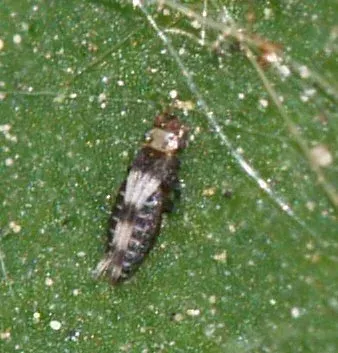
The beech thrips, known scientifically as Dendrothrips ornatus, belongs to the order Thysanoptera and the family Thripidae. These are very small insects, typically measuring between 1.0 to 1.5 mm in length.
Adult thrips are distinguished by their specific wing patterns and body coloration, which help entomologists identify them in forest and nursery environments.
The larvae are significantly smaller than the adults and lack developed wings, appearing yellowish or whitish, which allows them to hide effectively on the underside of leaves.
They possess a rasping-sucking mouthpart, which is characteristic of the Thripidae family, designed for breaking the plant epidermis to reach the cellular sap.
The lifecycle includes several developmental stages, from eggs laid in leaf tissues to various nymphal stages that typically occur in the leaf litter or near the plant base.
What it damages
The primary host for Dendrothrips ornatus is the European beech (Fagus sylvatica), although it has been observed on some lime tree species as well.
Damage is caused by both adults and larvae feeding on the leaf cells, which leads to the collapse of the leaf structure and a significant reduction in photosynthetic capacity.
Feeding usually begins on young, tender leaves, causing them to develop pale spots that later turn brown or necrotic as the tissue dies off.
High populations can lead to severe crown defoliation, particularly in young saplings, causing reduced growth rates and increased susceptibility to secondary infections.
Economic damage is most significant in nurseries and ornamental beech plantings where aesthetic appeal and uniform growth are highly valued requirements.
When it appears
The pest emerges in early spring, synchronized with the bud break of beech trees, allowing adults to start feeding on the freshest, most nutritious foliage.
Activity peaks during the warm summer months; high temperatures significantly reduce the duration of the lifecycle, leading to multiple overlapping generations.
The population density typically remains high throughout the summer if environmental conditions—particularly lack of rainfall—persist, stressing the host trees.
As autumn approaches, adults seek overwintering sites in the soil, leaf litter, or under the bark of the host tree to survive the cold winter period.
Monitoring should be most intense during the spring and early summer when the first generations of larvae are emerging and feeding on the canopy.
Signs of infestation
The most visible sign of an infestation is the appearance of small, silver-white, or translucent streaks and spots on the upper leaf surface.
Tiny black spots, representing the excrement of the insects, are a key indicator of presence and are commonly found on the undersides of the leaves.
Heavy infestations result in leaf curling, yellowing, and eventually premature leaf drop, leaving the canopy looking thin and discolored by mid-summer.
Stunted growth of new shoots is often observed in heavily infested saplings, as the plant loses energy required for tissue development due to sap loss.
- Silver or translucent patches on leaves.
- Black excrement dots on the underside of leaves.
- Leaf curling and deformation.
- Premature yellowing of the canopy.
Control measures
Management of Dendrothrips ornatus involves an integrated pest management approach focusing on both biological and chemical strategies to protect trees.
Maintaining proper plant health through adequate irrigation is vital, as drought-stressed trees are significantly more susceptible to thrips attacks.
Removing and destroying fallen leaf litter during autumn can reduce the overwintering population, effectively lowering the number of adults that emerge in the spring.
For severe infestations in nurseries, the application of systemic insecticides that are absorbed by the plant tissue can provide long-lasting control of the larvae.
Encouraging natural predators such as lady beetles, lacewings, and predatory mites in the garden can help keep thrips populations below the economic threshold level.
Taxonomy
- Latin name
- Dendrothrips ornatus
- Order
- Thrips
- Family
- Thripidae
- EPPO code
- DENOOR
Discussion
No discussions yet — be the first.