
Western flower thrips
Anaphothrips occidentalis
Description
How to identify
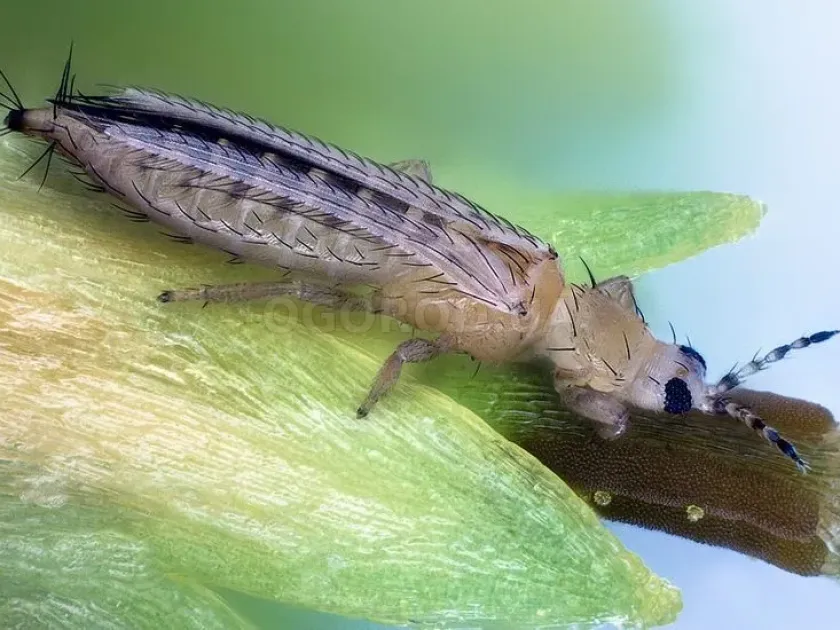
The Western flower thrips (Frankliniella occidentalis) is a member of the Thripidae family and is widely considered one of the most destructive agricultural pests worldwide.
Adult insects are extremely small, typically 1–2 mm in length, with variable coloration ranging from yellow to dark brown, making them difficult to spot without magnification.
The life cycle progresses through eggs, two larval stages, prepupa, pupa, and adult, with development rates being heavily dependent on ambient temperatures.
Their mobility and small size allow them to invade greenhouse facilities through vents, contaminated seedlings, or even on the clothing of agricultural workers.
Identification is best achieved by inspecting flowers and growing tips or by placing blue or yellow sticky traps to detect the presence of adults.
What it damages
As a highly polyphagous species, this thrips affects a vast array of crops, including vegetables, ornamental flowers, and various fruit-bearing plants.
Damage is caused by both larvae and adults, which pierce plant cells to feed on the sap, leading to stunted growth, tissue necrosis, and reduced vigor.
Beyond direct feeding damage, they are the primary vectors for the Tomato Spotted Wilt Virus (TSWV) and Impatiens Necrotic Spot Virus (INSV), causing significant yield losses.
Floral damage is common, manifesting as deformed blooms, discolored petals, and early bud drop, which renders ornamental plants commercially worthless.
Fruit crops often show surface scarring, silvery discoloration, and physical deformity, significantly reducing the marketability of the harvested produce.
When it appears
In greenhouse environments, Western flower thrips can complete their entire life cycle year-round if temperatures remain within an optimal range of 20–30°C.
In outdoor conditions, their activity increases during the warmer months, with population peaks usually observed in mid-to-late summer.
Migration between fields often occurs during harvest or through the wind, as they are capable of traveling short distances via air currents.
Population density often correlates with dry, hot weather, which facilitates faster development cycles and suppresses natural fungal enemies.
Proper seasonal management involves clearing crop residues after harvest to eliminate overwintering sites for pupae located in the soil.
Signs of infestation
A classic sign of infestation is the appearance of silvery or greyish streaks on foliage, which are areas where chlorophyll has been removed by feeding.
Small black specks of excrement, often found on the underside of leaves or within flower buds, are a definitive indicator of thrips presence.
Plants may show irregular, twisted leaves and distorted growing tips, often mistaken for herbicide damage or hormonal imbalances.
Flowers might open unevenly or fail to develop properly, with visible necrotic spotting on the petals before or during anthesis.
- Silvery-white leaf surface scarring.
- Tiny black excrement dots on plant tissue.
- Distorted or curled new growth.
- Spots and necrosis on flower petals.
- Abortion of flower buds and immature fruit.
Control measures
Effective management requires an Integrated Pest Management (IPM) approach that focuses on prevention, biological control, and judicious pesticide use.
Regular monitoring with colored sticky traps is essential to detect pest arrival early and track population trends for timely intervention.
Biological control agents, such as predatory mites (e.g., Amblyseius spp.) and minute pirate bugs (Orius spp.), are highly effective at suppressing populations.
Chemical control should only be used as a supplementary measure, with strict rotation of chemical classes to mitigate the risk of resistance development.
Cultural practices, including weed control in and around the greenhouse and the use of insect-proof netting, form the first line of defense against infestation.
Taxonomy
- Latin name
- Anaphothrips occidentalis
- Order
- Thrips
- Family
- Thripidae
- EPPO code
- ANAPOK
Discussion
No discussions yet — be the first.