
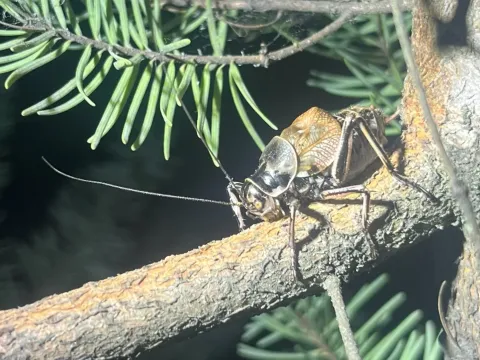
Great grig
Cyphoderris monstrosa
The Great grig (Cyphoderris monstrosa) belongs to the family Haglidae and is a relict species of Orthoptera. The insect is characterized by a bulky, slightly humped body, which gives it its distinctive common name.
What the section contains
Great grig
The coloration of this pest ranges from dark brown to almost black, aiding its camouflage against the forest floor. Males possess specialized wings adapted for stridulation, while females have long, sabre-like ovipositors designed for laying eggs in the soil.
Adults reach 3–4 centimeters in length. A unique feature of this species is its nocturnal lifestyle, which makes visual detection difficult during daylight hours while monitoring agricultural fields or garden plots.
Systematically, this species is of interest to scientists as a "living fossil." In an agronomic context, it is considered an occasional pest capable of causing damage when population densities are high near forested areas.
The presence of the Great grig can be identified by the loud, characteristic nocturnal chirping of males, which sounds similar to certain cicada or cricket species but at a lower frequency.
The primary damage caused by Cyphoderris monstrosa involves the consumption of young shoots, leaves, and reproductive organs of cultivated plants. This species is primarily a phytophage, preferring the soft tissues of developing plants.
Berry bushes and young saplings of fruit trees are most frequently affected by this insect's activity. In cases where natural food sources are scarce, the grig may switch to vegetable crops located near forest edges.
Damage manifests as uneven nibbling of leaf blades, often starting from the edges, creating a lacy appearance. In cases of severe infestation, the grigs can completely destroy young flower buds, negatively impacting the future harvest.
Beyond direct feeding, the pest can damage the bark of young branches by gnawing it for sap or to create egg-laying sites, which creates entry points for pathogenic fungi and bacteria.
The greatest economic losses occur in years of mass reproduction, when significant groups of grigs migrate from wild habitats to cultivated land in search of succulent vegetation.
The life cycle of this species is closely tied to the climatic conditions of mountainous and submontane regions. Nymphs emerge from eggs in the spring once the soil warms up to optimal temperatures.
The grig develops via incomplete metamorphosis. The active feeding period for nymphs occurs in early summer, when plants are in their most intensive growth phase.
Adults appear in the second half of summer, typically during July and August. It is during this period that their activity peaks, and the most noticeable damage to agricultural crops is recorded.
In the autumn, adult grigs mate and deposit eggs into the soil. The eggs are the life stage that survives the winter, ensuring the species' survival through harsh mountain winters.
Thus, primary pest monitoring should be conducted from late June through August, when the population of adults and older-stage nymphs is at its highest.
A clear sign of the grig's presence is the discovery of leaves with characteristic jagged edges. Unlike caterpillars, these insects often leave behind droppings of a specific shape on the foliage.
Nocturnal chirping in the garden or field serves as the primary indirect evidence of a Cyphoderris monstrosa population. If the sound becomes pervasive, the risk of plant damage increases significantly.
Inspecting the soil in the root zones can reveal small holes left by females during oviposition. This is a critical indicator for an agronomist that preventive measures are necessary.
During morning hours, the pests can be found hiding under fallen leaves, rocks, or deep within weeds near cultivated plants. They show low activity until dusk.
The presence of many "stripped" branches, lacking a portion of their leaves, near the boundaries of a field bordering wild forest indicates active feeding activity by the insects.
Protection measures primarily involve agronomic techniques. Regular weeding around the plot deprives the pest of shelters and alternative food sources.
Manual collection of insects at night using lanterns is effective on small garden plots. This can significantly reduce population density before egg-laying occurs.
The application of broad-spectrum insecticides is justified only in cases where the damage threshold is critically exceeded. It is recommended to use products with stomach and contact action.
Biological control methods include attracting natural predators, such as birds and small predatory mammals, to the area. Installing birdhouses and creating nesting conditions for beneficial fauna provides long-term effects.
To protect individual valuable plants, physical barriers such as fine mesh nets or horticultural fleece can be used to restrict the pest's access to the aerial parts of the crop.