
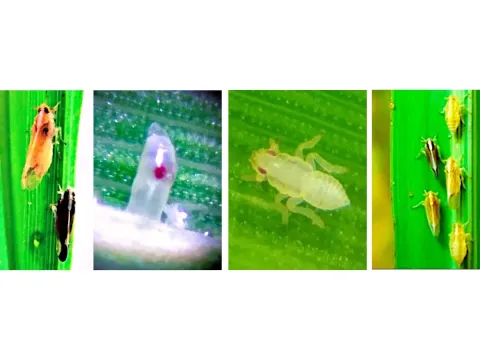
Sogata vibrix
Sogata vibrix
Sogata vibrix is a small insect belonging to the order Hemiptera and the family Delphacidae. These insects, commonly referred to as planthoppers, possess a slender body and transparent wings, making them well-adapted for movement within dense cereal crops.
What the section contains
Sogata vibrix
The adult coloration typically ranges from light yellow to brownish, providing excellent camouflage against cereal foliage. They are equipped with piercing-sucking mouthparts specifically evolved to extract sap from plant tissues.
Nymphs share a similar morphology with adults but are smaller and lack fully developed wings. They undergo several developmental stages, progressively increasing in size and exhibiting traits characteristic of mature specimens.
The life cycle consists of eggs, several nymphal instars, and adults. In warm, humid climates, the developmental cycle is rapid, which can lead to exponential population growth within a short timeframe during the growing season.
These insects prefer the humid microclimate found in rice paddies and surrounding wetlands, displaying peak activity levels during the vegetative growth phase of the host plants.
Sogata vibrix primarily targets cereal crops, with rice being its most significant economic host. They are also known to survive on various wild grasses that serve as reservoir hosts during the off-season.
Feeding occurs through the intense extraction of plant sap by both adults and nymphs. This process disrupts the plant's vascular system, leading to nutrient imbalance and impaired physiological functions.
Severe infestations cause stunted growth, premature yellowing (chlorosis), and wilting of leaves. The loss of turgor pressure significantly diminishes the plant's ability to produce grains, leading to empty panicles.
Beyond physical injury, these planthoppers act as potential vectors for various plant viruses. Such diseases are often more destructive than the feeding damage itself, as they can cause rapid decline and crop death.
Without proper management, Sogata vibrix can reduce rice yields by 15-30%. The severity of impact depends on the timing of colonization and the overall health of the agricultural ecosystem.
Integrated Pest Management (IPM) is essential, starting with strict field hygiene, such as removing weeds and host grasses from bunds and irrigation channels to eliminate overwintering sites.
Utilizing resistant or tolerant rice varieties is a key strategic approach, as these plants are less attractive to the pest and show higher resilience to the sap-sucking activity.
Chemical control involves the timely application of systemic insecticides when monitoring indicates that population density has crossed the economic threshold. Neonicotinoids or organophosphates are often employed.
Monitoring programs using yellow sticky traps are highly recommended to track population fluctuations and determine the optimal window for targeted insecticide applications.
Conservation biological control, including the protection of natural predators like mirid bugs and parasitic wasps, plays a vital role in maintaining the pest population below economically damaging levels.