
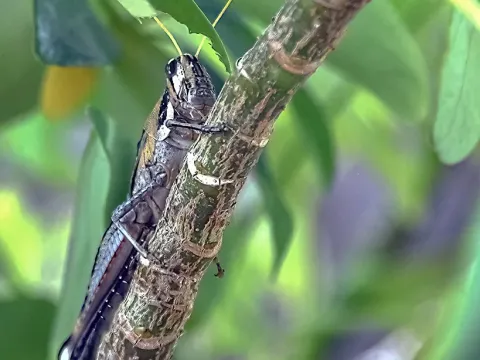
Vagrant grasshopper
Schistocerca vaga
The vagrant grasshopper (Schistocerca vaga) is a member of the order Orthoptera and the family Acrididae. It is a large, migratory insect known for its ability to travel long distances in search of food.
What the section contains
Vagrant grasshopper
Adults possess strong wings and powerful hind legs adapted for jumping. Their coloration typically blends with dry soil and vegetation, ranging from pale brown to grayish tones.
These insects exhibit a hemimetabolous development cycle, passing through egg, nymph, and adult stages. They lay their eggs in clusters, protected by pods buried within the soil.
Their biological success is largely due to their ability to exploit arid and semi-arid environments, where they can survive and breed rapidly when weather conditions allow.
In migratory phases, these grasshoppers can form large groups that pose a significant threat to agricultural productivity across various climate zones.
As a generalist herbivore (polyphage), the vagrant grasshopper feeds on a wide range of plants, including cereals, legumes, vegetables, and ornamental trees.
During outbreaks, these pests can cause severe economic loss by rapidly stripping foliage from crops, often leaving only the stems behind.
Both nymphs and adults contribute to crop destruction. They consume leaves, stems, and reproductive parts, which severely impairs the plant's ability to produce yield.
Damage is most severe during periods of drought when natural rangeland vegetation dries up, forcing swarms to invade cultivated fields for sustenance.
- Cereal crops like wheat and barley.
- Forage grasses and pastures.
- Vegetable gardens and orchards.
The most obvious sign of an infestation is the sudden arrival of large numbers of grasshoppers, often characterized by a loud buzzing sound produced by flying swarms.
Visual inspection will reveal shredded leaf margins and missing tissue, with plants sometimes looking skeletonized if the population density is sufficiently high.
Finding egg pods in the soil during autumn or winter is a key indicator that a major hatching event may occur in the field during the following spring.
The presence of large amounts of frass (excrement) on the ground and leaf surfaces is a clear indication of active feeding by a locust population.
Rapid canopy thinning and sudden loss of crop vigor are critical signs that require immediate scouting for nymphal development or adult presence.
Chemical control involving approved insecticides is the primary method for managing large-scale outbreaks, especially when nymphs are in their early instars.
Cultural practices, such as deep tillage or plowing, are highly effective at disturbing soil-embedded egg pods, leading to exposure and desiccation of the eggs.
Integrated pest management programs rely on systematic field scouting to detect populations early, allowing for targeted applications rather than widespread spraying.
Biological control agents, including specific entomopathogenic fungi, are being researched and utilized as environmentally friendly alternatives for suppression.
Maintaining clean field borders and managing weed growth around the farm can minimize the appeal of the area as a breeding and feeding ground for the pest.