
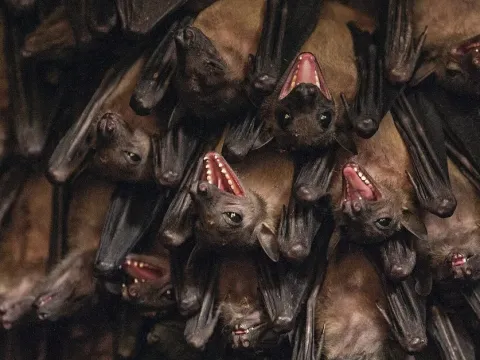
Egyptian fruit bat
Rousettus stramineus
The Egyptian fruit bat (Rousettus aegyptiacus) belongs to the Pteropodidae family. It is a large bat species with a wingspan reaching up to 60 centimeters.
What the section contains
Egyptian fruit bat
Unlike other microbats, this species uses a crude form of echolocation, which allows it to navigate in complete darkness within caves and dense vegetation.
They have a distinctive fox-like facial structure and brown-to-grey fur, which helps them blend into the foliage of fruit trees while roosting or feeding at night.
The species is highly gregarious, living in large colonies that can consist of thousands of individuals, which significantly increases the pressure on local food sources.
Reproductive biology is characterized by a stable birth rate, allowing the colony to maintain its size despite environmental pressures and control attempts.
The Egyptian fruit bat is recognized as a major agricultural pest in the Middle East and Africa, causing severe damage to fruit production industries.
They feed on a wide variety of commercial crops, including dates, figs, mangoes, and citrus. They are known to strip orchards of fruits overnight, leading to massive financial losses.
By biting into the fruit, they create openings that attract secondary pests such as wasps, flies, and various fungi, accelerating the spoilage of the entire harvest.
Their weight and the size of the foraging groups cause mechanical damage to branches and young trees, often resulting in broken limbs and reduced tree vigor.
The cumulative damage is often so severe that entire harvests can be rendered non-marketable in a matter of a few weeks during the ripening season.
The damage is most severe during the fruit ripening stage, which varies depending on the crop and the geographic location of the orchards.
As nocturnal animals, they start their feeding flights at dusk and continue through the night, returning to their roosting sites before dawn.
Their seasonal presence is tied to the availability of ripe fruit. When crops are not yet ripe, these bats may move to different areas, searching for native or alternative food sources.
Predicting their arrival is difficult due to their nomadic nature; they can travel long distances to locate and exploit high-energy food sources like sugar-rich fruits.
Seasonal control measures are most effective when applied proactively, just before the fruits reach the maturity level preferred by the bats.
A primary sign of an infestation is the presence of partially eaten fruits scattered on the ground or left hanging on the trees with distinctive bite marks.
The presence of large amounts of guano and fruit debris under the canopy is a clear indicator that a colony has been visiting the site regularly.
Farmers can hear the characteristic vocalizations and wing noise of a large group of bats while they are foraging in the trees during the night.
Mechanical damage, such as snapped twigs and damaged leaves, provides physical proof of the bats' activity within the orchard canopy.
Rotting fruit on the trees, accompanied by a specific, pungent odor, suggests that the bats have been feeding in the area for several nights.
The most reliable method of protection is the use of high-quality exclusion netting, which prevents the bats from reaching the fruits while allowing normal growth.
Acoustic deterrents that broadcast distress calls or high-frequency pulses can reduce the number of visitors, though effectiveness often wanes as bats habituate.
Orchard management techniques, such as keeping the canopy open and clearing fallen fruit from the orchard floor, make the area less attractive to roosting or feeding bats.
- Harvesting fruits promptly as soon as they reach the minimum required maturity.
- Using visual deterrents like shiny strips or scarecrows to disrupt the bats' flight patterns.
- Coordinating with neighboring farms to monitor colony locations and reduce pressure collectively.
Chemical control is rarely recommended due to the ecological risks to other beneficial species and the limited effectiveness against such a highly mobile population.