
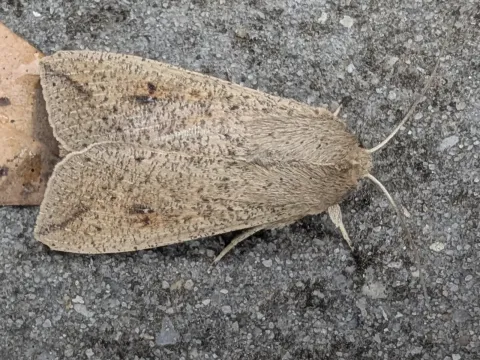
True armyworm
Pseudaletia
The True armyworm (Mythimna unipuncta, formerly Pseudaletia unipuncta) is a member of the Noctuidae family. Adult moths feature a wingspan of 40–45 mm with a characteristic small white spot in the center of their forewings.
What the section contains
True armyworm
Larvae, commonly known as armyworms, progress through six instars. They typically display a dull brownish or greenish color with three distinct light-colored stripes along the dorsal side.
Pupation occurs in the soil. The pupae are smooth and dark brown, serving as the primary overwintering stage in many temperate regions.
The life cycle length is heavily influenced by temperature, with warmer seasons allowing for faster development and multiple generations per year.
Adult moths are nocturnal and highly mobile, often migrating long distances to find suitable host plants for oviposition.
The species is a significant pest of cereal crops, including wheat, barley, corn, oats, and rice, causing substantial economic losses globally.
Larvae consume large amounts of leaf tissue. In severe infestations, they can defoliate entire plants, leaving only the stalks or midribs.
As the name suggests, "armyworms" move in large groups when their food source is depleted, invading adjacent fields and causing widespread damage.
Beyond leaves, older larvae may attack the heads of grain crops, leading to direct yield loss and increased vulnerability to pathogens.
Vegetable crops and turfgrass are also susceptible, particularly during outbreaks when high larval densities push them to feed on non-traditional hosts.
Adult moths emerge in early spring, often arriving via wind currents from warmer overwintering areas, and immediately begin mating.
The first generation of larvae typically appears in late spring or early summer, coinciding with the rapid growth stages of cereal crops.
Summer generations are often the most destructive, occurring when crops are approaching the reproductive or grain-filling stages.
Outbreaks are frequently correlated with cool, wet spring conditions followed by periods of lush plant growth, which favor larval survival.
Late-season populations can present a risk to fall-seeded cereal crops, necessitating monitoring for early-stage infestations.
Early symptoms include small, irregular feeding notches on leaf margins, which are often overlooked during initial scouting.
The presence of abundant dark-colored fecal pellets (frass) at the base of plants or on leaf surfaces is a clear indicator of larval activity.
Mass defoliation of leaves, often starting from the bottom of the plant and moving upward, is a hallmark of an established armyworm population.
The sound of feeding—a faint rasping—can sometimes be detected in dense, infested fields during quiet nights when activity peaks.
Finding "skeletonized" leaves and severed stems indicates that the larvae are in later instars and are causing maximal damage.
Cultural practices such as deep tillage can effectively bury and destroy pupae, significantly reducing the success of the overwintering population.
Maintaining clean field borders by removing grassy weeds eliminates egg-laying sites and reduces the likelihood of initial infestation.
Monitoring using light or pheromone traps helps detect moth flights early, allowing for timely intervention before larval populations explode.
Insecticide application is the most common emergency control method, utilized when larval density exceeds established economic thresholds.
- Scout fields regularly during late afternoon or night.
- Utilize biological insecticides like Bacillus thuringiensis for early instars.
- Implement crop rotation to disrupt pest life cycles.