
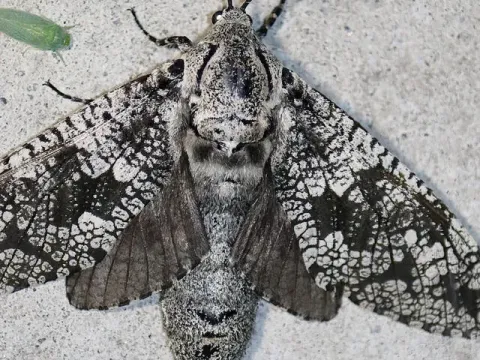
Goat moth (Prionoxystus maemurtaei)
Prionoxystus maemurtaei
Prionoxystus maemurtaei belongs to the order Lepidoptera, family Cossidae, commonly known as goat moths or carpenter moths due to the wood-boring habits of their larvae.
What the section contains
Goat moth (Prionoxystus maemurtaei)
Adult moths are heavy-bodied with cryptic coloration that provides excellent camouflage against tree bark, making them difficult to spot during daylight.
The larvae are large, robust caterpillars with powerful, hardened mandibles capable of boring through dense xylem and phloem tissues of trees.
The life cycle involves multiple larval stages, with the insect spending the majority of its life deep within the wood, which is a key survival strategy.
Morphologically, they are characterized by well-developed thoracic plates, providing the necessary leverage for larvae to anchor themselves while excavating long tunnels.
The larvae primarily infest various hardwood tree species, causing severe physiological stress and structural damage to the host plant.
By boring extensive galleries inside the trunk, they disrupt the vascular system, significantly reducing the tree's ability to transport water and nutrients.
Large infestations compromise the structural integrity of the wood, leading to increased risk of wind damage and tree mortality in forested areas.
Furthermore, these galleries provide entry points for secondary pathogens, such as wood-decay fungi, which further degrade the quality of the timber.
In ornamental settings, heavy damage can lead to branch dieback and eventual death of mature trees, resulting in significant aesthetic and economic losses.
Adult moth activity typically peaks during the warm summer months, when mating and egg-laying occur on the bark of susceptible hosts.
After hatching, the larvae immediately seek entry points to penetrate the bark and begin tunneling into the protective interior of the tree.
Development is relatively slow, often spanning multiple years depending on the host species and regional climatic conditions of the habitat.
The larvae overwinter deep inside the wood, remaining quiescent during cold periods and resuming feeding activity as soon as temperatures rise in spring.
Pupation occurs near the exit holes late in the cycle, allowing the emerging adult moths to escape easily and begin the next generation.
The presence of Prionoxystus maemurtaei is often indicated by the accumulation of frass, or wood shavings, at the base of the infested tree.
- Entrance holes on the bark surface, sometimes accompanied by sap flow or bleeding.
- Premature yellowing of leaves or wilting of the crown, signaling a decline in tree health.
- Dieback of twigs and smaller branches due to internal gallery disruption.
- Hollow sounds when the trunk is tapped, indicating extensive internal tunneling.
- Peeling bark exposing the larval galleries in advanced stages of infestation.
These external cues are vital for early detection, as the majority of the internal destruction occurs before symptoms become outwardly visible.
Sanitation is the cornerstone of control; removing and destroying infested trees prevents the population from spreading to healthy neighbors.
Pheromone traps are highly effective for monitoring adult flight periods and timing the application of any necessary pest suppression efforts.
Direct intervention involves injecting systemic insecticides into larval galleries, which can effectively target the pest inside the trunk.
Promoting tree vigor through proper fertilization, irrigation, and avoiding mechanical injuries helps trees naturally resist successful colonization.
Encouraging natural predators, such as woodpeckers and parasitic wasps, provides an ecological layer of protection against mass outbreaks of this borer.