
Oak platypus
Platypus quercivorus
The oak platypus is a small beetle belonging to the Curculionidae family, specifically the Platypodinae subfamily. These insects have a slender, cylindrical body, dark brown in color, typically measuring around 5 mm in length.
What the section contains
Oak platypus
Their morphology is highly specialized for boring into wood, featuring a head and pronotum adapted for creating deep, gallery-like tunnels within the tree trunk.
Larvae are legless and white, developing within these tunnels while feeding on symbiotic fungi. The adult females carry spores of these fungi in specialized body structures known as mycangia.
Unlike bark beetles, the oak platypus bores deep into the sapwood and heartwood, creating a perpendicular system of galleries that significantly compromises the tree's structure.
This species is recognized as a serious invasive pest, particularly in regions where environmental stress increases the vulnerability of hardwood forests.
The primary hosts of this beetle are oak species, though it is also known to attack beech, chestnut, and other deciduous broad-leaved trees.
The beetle targets stressed, old, or declining trees, but high population densities allow it to successfully colonize even healthy specimens experiencing temporary environmental pressure.
Infestation leads to severe physiological disruption, preventing the transport of water and nutrients, which eventually leads to the rapid decline and death of the tree.
Damage is exacerbated by the introduction of pathogenic fungi during boring, which often causes vascular diseases such as Japanese oak wilt.
The timber quality is severely degraded by the presence of numerous boreholes and fungal staining, rendering it commercially worthless.
The active flight period for adults typically begins in the spring when temperatures rise sufficiently to trigger beetle emergence from their overwintering sites.
The main dispersal flight usually occurs between May and July, heavily influenced by regional climatic conditions and the specific microclimate of the forest stand.
Depending on the latitude and season length, the species can produce one or two generations per year, with life stages occurring inside the galleries.
Drought conditions significantly increase the likelihood of infestation, as stressed trees fail to produce sufficient resin or defensive compounds to repel the beetles.
Adults are most active during the evening hours when they seek new host trees, attracted by volatile chemical signals emitted by weakened trees.
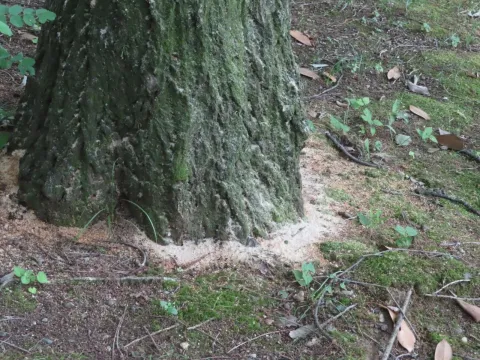
The most reliable sign of an infestation is the appearance of small, circular entry holes on the bark, accompanied by fine white wood dust known as frass.
In cases of intense colonization, one may observe sawdust accumulating at the base of the trunk or dark streaks on the bark surface.
- Circular entry holes on the main trunk.
- Accumulation of fine wood flour at the base of the tree.
- Sudden yellowing or wilting of the crown.
Internally, infested wood reveals complex, systematically arranged tunnels, often stained black or dark brown due to the growth of symbiotic fungal gardens.
As the tree weakens, the bark may begin to loosen, and secondary insects, such as bark beetles or wood wasps, may move in to colonize the dying material.
Sanitation is the most effective control strategy, involving the prompt felling and removal of infested trees to eliminate brood sources before the next generation emerges.
Promoting forest health through proper management, such as thinning and irrigation during drought, helps maintain the natural resistance of oak stands.
Pheromone traps are used for monitoring beetle populations, allowing foresters to identify and react to outbreaks before they become widespread.
Chemical control via systemic insecticides may be considered for high-value individual trees or in nurseries, though it is difficult to reach beetles deep in the wood.
Strict quarantine measures on the transport of untreated logs are essential to prevent the spread of the oak platypus to uninfested geographic areas.